
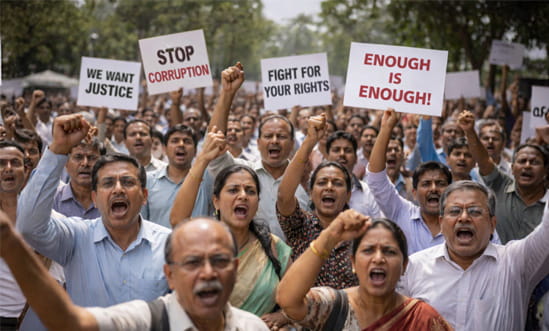
The delay in announcing the January 2026 Dearness Allowance and Dearness Relief revision has now become a serious concern for central government employees and pensioners. What is usually treated as a routine financial update has turned into a wider issue of frustration, uncertainty, and growing pressure on the government to act. A fresh report says a central government employee body has called for protest action, bringing the DA/DR delay into sharper public focus.
At the centre of the issue is the pending DA/DR instalment that is due from 1 January 2026. Employees and pensioners have been waiting for the government’s formal announcement, but as of 15 April 2026, the latest publicly visible central government records still show the earlier notified rates. The Department of Expenditure’s DA page continues to display the previous official revisions, while the Pensioners’ Portal DR table still reflects 58% from 1 July 2025 as the latest visible rate.
That is why the current development matters. This is not a story about a fresh DA hike being officially granted. It is a story about the continued delay in announcing it. According to the Economic Times report, the Confederation of Central Govt. Employees & Workers has informed the Cabinet Secretary that affiliated organisations will hold a lunch-hour demonstration on 16 April 2026 to demand the immediate release of the pending DA/DR instalment.
This protest call reflects a wider mood among employees who feel that a cost-of-living allowance should not remain pending for so long. DA and DR are meant to offset the effect of inflation. For serving employees, that money directly affects monthly financial planning. For pensioners, Dearness Relief matters even more because it supports fixed post-retirement income at a time when expenses on essentials and healthcare continue to rise. Even when arrears are eventually paid, the delay still creates anxiety and a sense of being kept waiting for something that is already due.
The last confirmed central government DA revision was the increase effective from 1 July 2025, which took the rate to 58%. That order is already reflected on official government sources. Before that, the DA rate from 1 January 2025 stood at 55%. The absence of a new visible notification for the January 2026 instalment is what has now triggered both speculation and unrest.
Much of the ongoing discussion is focused on what the next rate could be. Media calculations and employee-side expectations have widely pointed to a 2% increase, which would raise DA/DR from 58% to 60%. But this figure is still only an estimate until the government formally approves and notifies it. That distinction is important because projections often begin circulating as if they are final decisions, which can create confusion among employees and pensioners following the story closely.
The report also suggests that the proposed demonstration may see participation from workers in departments such as Income Tax, Postal, Agriculture, Botanical Survey of India, Geological Survey of India, and Survey of India. That gives the issue a broader institutional dimension. It shows that the demand is not being voiced by a small isolated group, but by organisations that believe the delay has now become significant enough to require visible action.
For readers, the most important point is to separate confirmed facts from expected outcomes. The confirmed part is that a central government employee body has called for protest over the delay. The confirmed official rate visible on government portals remains 58% from 1 July 2025. The expected part is the possible move to 60%, but that remains unofficial until a fresh order is issued.
This is why the DA/DR delay is now more than a routine administrative lag. It has become a matter of credibility and timing. Every delayed announcement raises fresh questions among employees and pensioners about when financial relief will actually reach them. If the government releases the order soon, the issue may settle quickly. But until that happens, the delay is likely to remain a major talking point across unions, pensioner groups, and public-sector news platforms.
For now, the situation remains clear: the demand for the January 2026 DA/DR revision is growing louder, the protest call has added urgency, and employees and pensioners are still waiting for the official word that will finally end the uncertainty.