
The 8th Pay Commission discussion has entered a more serious phase after the Confederation of Central Government Employees and Workers formally served a strike notice to the Cabinet Secretary. The notice called for a one-day nationwide strike on 12 February 2026 and placed several key demands before the government, many of which are directly connected to salary revision, pension issues, and service conditions under the 8th CPC framework.
This development is important because it shows that the 8th Pay Commission is no longer being viewed only as a future pay revision exercise. It is now emerging as a live issue tied to immediate financial concerns of employees and pensioners. What was once mainly a matter of waiting for recommendations has now turned into an active pressure point involving staff unions, retired personnel, and serving employees from multiple departments.
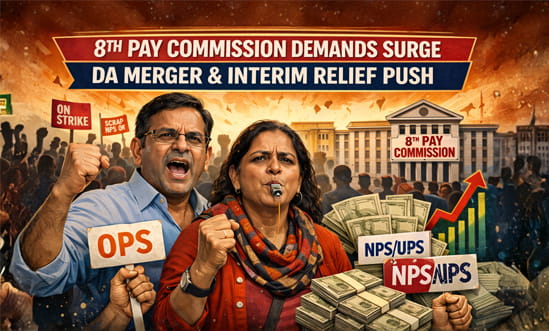
As per the strike charter made public by the employee side, Part A is largely focused on service and pension-related matters. Among the major demands are changes in the Terms of Reference of the 8th CPC, merger of 50% DA/DR with basic pay and basic pension, grant of 20% interim relief from 1 January 2026, restoration of the Old Pension Scheme by ending NPS/UPS, and removal of inequalities among pensioners. The charter also presses for release of the 18 months DA/DR arrears that were frozen earlier and seeks restoration of the commuted portion of pension after 11 years instead of 15 years.
Along with these headline demands, the notice also raises several long-pending staff issues. These include compassionate appointments, filling up sanctioned vacant posts, stopping outsourcing and corporatisation, implementing Board of Arbitration awards, and regularising casual, contingent, contractual, and GDS employees. This makes the strike notice broader than a simple wage demand. It presents the 8th CPC debate as part of a larger employee welfare and service-rights struggle.
The larger argument being made by employees is straightforward. Even if the 8th Pay Commission takes time to submit recommendations and even more time for implementation, the financial burden on employees and pensioners is already being felt. That is why two demands stand out sharply in the present context: DA merger and interim relief.
If the government accepts a merger of DA/DR at the 50% level, it would increase the base pay or pension on which future revisions may be built. Interim relief, on the other hand, is being demanded as temporary financial assistance until the 8th CPC recommendations are finalised and implemented. Whether the government agrees to these demands remains uncertain, but the strike charter makes it clear that employee organisations do not want to wait silently through the full Pay Commission cycle.
This issue becomes even more significant because the official 8th CPC exercise is still at the consultation stage. The 8th Central Pay Commission was constituted on 3 November 2025, and the Commission later opened formal channels for stakeholders to submit questionnaires, memoranda, and representations. According to the available schedule, responses to the questionnaire were extended up to 31 March 2026, while the online memorandum and representation window has been kept open from 5 March 2026 to 30 April 2026.
This means the Commission is still in the process of gathering views, studying demands, and documenting stakeholder submissions. At the same time, employee unions appear to be using collective pressure to ensure that their most urgent concerns are not ignored during this stage.
On the government side, the process continues to move in an official and procedural manner. Recent updates on the 8th CPC platform, including notices such as the 24 April 2026 Dehradun visit, suggest that the Commission remains engaged in consultations and outreach rather than final recommendation drafting. That is why the strike notice carries both administrative and political weight. It does not mean that any final relief has already been approved. What it does show is that organised employee groups are trying to influence the agenda before the Commission reaches its recommendation stage.
For Central Government employees, railway staff, defence civilians, CAPF personnel, postal employees, and pensioners, the message is now quite clear: the 8th Pay Commission story is moving on two tracks at the same time. One track is the formal consultation process being run by the Commission. The other is the growing pressure campaign from employees and unions who want immediate attention on issues like pay revision, pension equity, OPS restoration, DA arrears, pension commutation, and interim support.
Whether the government responds directly to the strike notice or not, one fact is already visible. The 8th Pay Commission is no longer being discussed only as a future salary formula. It is increasingly becoming a present-day welfare issue for lakhs of employees and pensioners who believe that relief cannot wait until the final report is delivered.
Watch the full video for complete details!


Leave a Reply