

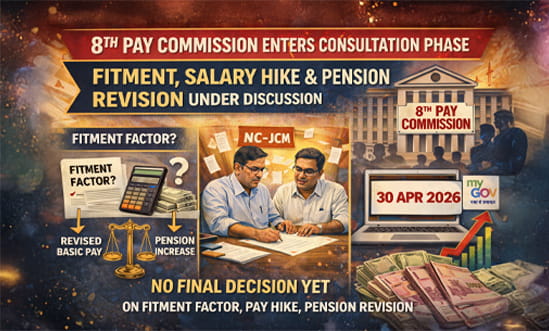
The 8th Pay Commission has now moved into an important working phase, which is why discussion around fitment factor, salary revision, pension changes, and defence parity is growing sharper by the day. At the same time, one point must be stated clearly: there is still no final official decision on the fitment factor, revised basic pay, pension increase, or date of implementation. At this stage, what is unfolding is not a final award, but a formal process of consultations, staff-side submissions, and structured inputs that will influence the Commission’s eventual recommendations.
One of the biggest recent developments is the 13 April 2026 meeting of the NC-JCM drafting committee, where employee-side representatives are expected to finalise a common memorandum for submission to the 8th Central Pay Commission. This step is important because the memorandum is likely to combine major concerns related to pay, pension, allowances, service conditions, and unresolved anomalies. In practical terms, this is the moment when employee concerns start moving from discussion to an organised policy document.
On the official front, the 8th CPC website continues to show the 30 March 2026 Dehradun visit notice as its latest major public update. As per that notice, the Commission is scheduled to visit Dehradun on 24 April 2026 as part of its ongoing stakeholder consultation exercise. This indicates that the Commission is still in the stage of hearing views, gathering evidence, and receiving formal inputs before reaching any conclusion on pay and pension revision.
Another point that matters for employees and pensioners is the submission mechanism itself. The questionnaire route closed on 31 March 2026, and the Commission had made it clear that responses under that route were to be submitted only through MyGov. However, the larger channel for memoranda and representations remains open until 30 April 2026. This means unions, employee associations, pensioner bodies, departments, defence organisations, and even individuals still have time to place their demands before the Commission in a formal manner.
This is exactly why the fitment factor debate has taken centre stage. For most government employees, fitment factor is not merely a technical phrase. It is the key multiplier that determines how existing basic pay may be converted into revised basic pay under the new pay structure. Staff-side bodies are expected to push for a stronger revision, while many observers believe the final figure will depend on the government’s financial room, inflation trends, and its comfort with the Commission’s recommendations. Until an official recommendation is made and accepted, any fitment number circulating online should be treated as speculation.
For pensioners, the stakes are equally high. Any revised pay structure has a direct impact on pension expectations, Dearness Relief implications, possible arrears, and parity-related issues. In the defence sector, these questions become even more sensitive because concerns about parity, anomalies, representation, and clarity in implementation have remained alive since earlier pay commission cycles. That is why the 8th CPC is being watched not just as a salary revision mechanism, but also as a broader fairness test for both civil and defence stakeholders.
The timeline is another important factor. The government has already informed Parliament that the 8th Central Pay Commission was constituted in November 2025 and has been given 18 months to submit its recommendations on pay, pension, and allowances. That means the process still has a long road ahead, and expectations of an immediate salary order or pension notification should be viewed with caution. In the coming months, employees are likely to see more debate, more pressure, and more organised demands, but not an instant rollout.
So where does the 8th Pay Commission story stand right now? It is at a crucial but unfinished stage. The consultation process is active. The employee side is consolidating its demands. The memorandum route remains open. The Commission is continuing its outreach and evidence-gathering work. But the final outcome on fitment factor, pension revision, DA/DR treatment, interim relief, arrears, and implementation timing will become clear only after the Commission submits its report and the government takes a final decision on those recommendations.
For central government employees, pensioners, and the defence community, the real takeaway is simple: the 8th Pay Commission is no longer just a topic of rumours or headline-driven speculation. It has now entered the documentation, consultation, and negotiation phase. That may sound procedural, but in policy terms, this is the stage where the real foundation for future salary and pension revision is actually being laid.
Watch the full video for complete details!


Leave a Reply