

The 8th Pay Commission has become one of the most closely watched developments for central government employees, pensioners, defence personnel, ex-servicemen, railway staff, and postal employees across India. At this stage, one question is coming up again and again: where will the next meeting be held, and how can people find out in time? That question matters even more now because the process is moving increasingly through digital channels. In simple words, anyone who is not checking the right official platform at the right time could easily miss an important notice, deadline, or opportunity.
Until now, most discussions around the Pay Commission have focused on fitment factor, salary revision, pension increase, allowances, and changes in the pay matrix. But in the present phase of the 8th Pay Commission, another factor has become equally important: timely access to information. The Commission has begun functioning in a more digital and structured manner, which means following the official portal is no longer optional for serious stakeholders. It is necessary.
What makes this phase different is that the process is not limited to internal discussions within government departments. There is now a visible system through which associations, unions, pensioners’ bodies, and even individuals can track updates, submit demands, and identify opportunities to engage with the Commission. That is why people relying only on rumours, social media forwards, or incomplete video clips may end up missing the real developments.
Where can you check the next meeting?
If you want to know where the 8th Pay Commission’s next meeting or official visit is scheduled, the first step is to visit the official portal. The website carries several important sections, including the Terms of Reference, the composition of the Commission, contact details, earlier Pay Commission records, and, most importantly, the latest notices and visit calendar.
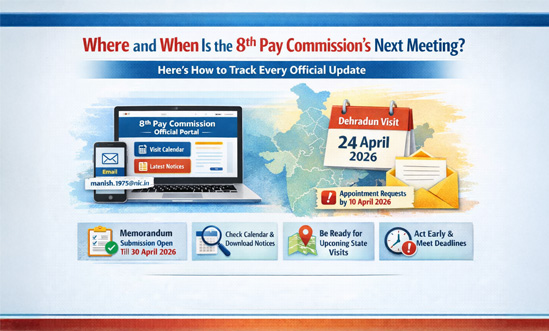
The visit calendar is currently one of the most important sections for employees and pensioners who want to stay informed. It helps users understand where the Commission team is likely to travel, on which date the programme is scheduled, and whether the event is relevant for stakeholders. At present, one of the most significant updates visible is the scheduled visit to Dehradun, Uttarakhand, on 24 April 2026. This clearly shows that the Commission is not operating only from Delhi, but is also moving towards ground-level consultations and stakeholder engagement.
Why is the Dehradun visit important?
The Dehradun visit should not be viewed as just another routine administrative event. It is an important opportunity for organisations, employee unions, pensioners’ groups, and other stakeholders who want their demands to be heard in a formal setting. For many groups, this is not only about filing an online submission. It is also about ensuring that their concerns are presented in an organised and visible manner before the Commission team.
One of the key aspects of this visit is that the appointment process appears to be clearly defined. Based on the available information, anyone seeking a meeting with the Commission team during the visit must submit a request within the prescribed timeline. The notice linked to the programme mentions a deadline of 10 April 2026 for appointment requests. This makes one thing very clear: the Commission is following a formal schedule, and missing the deadline could mean missing the opportunity altogether.
Can demands still be submitted?
Yes, and this is perhaps the most important point for stakeholders right now. The memorandum submission process for the 8th Pay Commission remains open, and the last date mentioned is 30 April 2026. That means employee associations, pensioners’ organisations, unions, service groups, and other interested bodies still have time to submit their demands formally.
This also becomes important because the earlier questionnaire response window, which had been extended up to 31 March 2026, is now closed. In other words, the questionnaire phase has ended, and the memorandum route has become the next major avenue for structured representation. For those who could not participate earlier, this is now the most important available channel.
How can you track the next meeting or visit?
This is exactly where many people fall behind. A large number of employees and pensioners assume that if something important happens, the news will automatically reach them. But that is rarely how these processes work. Important developments often begin with notices, event entries, appointment instructions, and submission deadlines. By the time the larger public discussion starts, the actual opportunity may already be gone.
To stay updated, people need to make a few habits part of their routine. First, they should regularly check the calendar and notices section on the official portal. Second, they should understand the symbols, categories, colours, or event markers used in the calendar, because these often help distinguish between internal meetings, visits, or stakeholder-related events. Third, they should open the event details and download the related notice, because the real instructions, timelines, contact details, and procedural requirements are often mentioned only in that official document.
This is a small step, but it creates a major difference between someone who is simply following the news and someone who is actively participating in the process.
Who should pay the most attention to this update?
It would be a mistake to look at the 8th Pay Commission only through the lens of salary increase. For different groups, the process carries different implications.
For serving employees, the issue is not limited to revised basic pay. It also includes allowances, transfer-related support, housing issues, TA/DA, hardship postings, and service conditions. If these matters are not recorded properly at the right stage, later complaints may have limited effect.
For pensioners, the matter is even more sensitive. Their concerns often revolve around pension revision, parity, commutation, medical benefits, and unresolved legacy issues. These matters are not always identical to the concerns of serving employees, which is why pensioners need strong and separate representation wherever necessary.
For defence personnel, ex-servicemen, and CAPFs, the process has an even sharper significance. Issues related to field hardship, disability concerns, risk exposure, uniformed service conditions, and operational realities are fundamentally different from ordinary civilian service concerns. If these issues are not clearly and forcefully represented, they may not receive the attention they deserve later.
Can an individual also submit a representation?
One encouraging aspect of the current system is that the process is not restricted only to large associations or established unions. There is scope for individuals also to raise their points through the official mechanism. This is especially important for employees and pensioners who may not be actively connected to a recognised body but still want to submit a reasoned demand or suggestion.
At the same time, caution is necessary. The correct route is the one prescribed on the official portal. Simply emailing a draft or forwarding a PDF outside the required system may not be treated as a proper submission unless it follows the official process. That is why understanding the procedure is just as important as preparing the demand itself.
What is the most common mistake people make?
The biggest mistake is waiting until the last moment. Government portals can become slow or difficult to access when deadlines are near. Someone trying to upload a submission on 29 or 30 April may face unnecessary technical trouble. Another common mistake is relying on social media summaries without reading the full notice. Partial information often creates confusion, and in matters involving deadlines and procedure, half-information can be costly.
A second major mistake is assuming that any draft will do. A meaningful memorandum needs clarity, structure, category-specific issues, and a strong factual basis. The side that presents its demands in a clear, organised, and timely manner usually stands on stronger ground.
If you want to know where the 8th Pay Commission’s next meeting is, the answer is no longer hidden behind speculation. It can now be tracked through the official portal, and that is the most important message at this stage. The process has gone digital, the opportunities are deadline-driven, and only those who remain alert will be able to ensure that their concerns are formally recorded.
As things stand, memorandum submission remains open till 30 April 2026, the questionnaire phase has already closed, and the Dehradun visit scheduled for 24 April 2026 shows that the Commission has entered an active stage of outreach and consultation. This is not just the time to discuss the Commission. It is the time to prepare, monitor official updates, and act within deadlines.
For employees, pensioners, defence personnel, and service organisations, one lesson is becoming increasingly clear: in this phase of the 8th Pay Commission, information is power. The people who track the right notice at the right time and present their concerns properly will have the best chance of making sure their voice becomes part of the official record.
Watch the full video for complete details!


Leave a Reply