


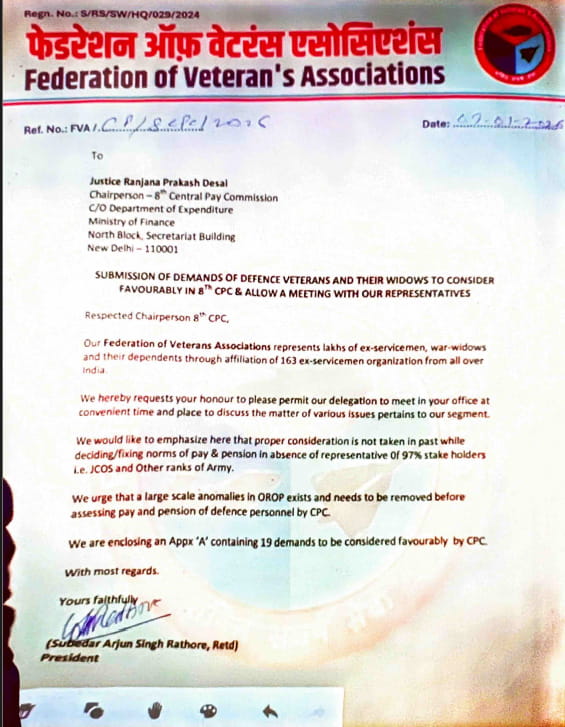
The 8th Pay Commission process is gathering pace, and a fresh development has now brought defence pension concerns into sharper focus. A veterans’ body has written to the Chairperson of the 8th Central Pay Commission, Justice (Retd) Ranjana Prakash Desai, seeking time for a delegation meeting to present long-pending pension and OROP-related issues.
This development is important because the Commission has already started moving toward stakeholder interactions. At this stage, groups that place their concerns on record in a proper and organised way may influence how major pay and pension questions are examined in the coming months.
What the latest representation says
According to the representation discussed in the update, the Federation of Veterans Association has again approached the Commission on 6 April 2026. In its communication, the federation has referred to an earlier letter sent in January 2026 and has requested a suitable appointment for a delegation meeting.
The main demand is straightforward. The organisation wants an opportunity to present defence pensioners’ concerns directly before the Commission instead of relying only on written submissions. The federation says it represents a large section of ex-servicemen, veer naris, disabled soldiers, and defence pensioners through 163 affiliated veteran organisations.
Why the veterans’ side wants a direct hearing
The core argument behind the request is that pension and pay decisions can become unfair when the concerns of major defence stakeholder groups are not fully heard during the consultation stage. In particular, the representation stresses that JCOs and Other Ranks must not be left out of the discussion when the next round of pay and pension reforms is being shaped.
For many veterans, this is not just about receiving a meeting slot. It is about making sure the realities on the ground are understood properly before any recommendations are finalised.
Key issues the federation wants to highlight
The representation appears to focus on a few major concerns.
First, the group does not want past pension and pay anomalies to be repeated under the 8th Pay Commission. It points to unresolved issues that continued even after the 7th CPC period.
Second, it says OROP-related complications should be examined through practical experience and not only through file-based interpretation. Many pension disputes look manageable on paper but create real hardship once they affect families, widows, and elderly veterans.
Third, the representation highlights the difficulty faced by many vulnerable beneficiaries, especially war widows, disabled soldiers, and elderly pensioners living in rural areas. Such individuals often do not have the means, health, or access to pursue long legal or administrative battles.
Fourth, the federation says it has already submitted a 19-point charter of demands, but believes an in-person interaction is still necessary. Their view is that some issues are better explained face-to-face, especially when the effect of policy decisions is not visible in a short written note.
The anomaly that could draw serious attention
One of the most sensitive points raised in the discussion is the claim that in some cases, veterans who retired after 2016 may be receiving lower pension than some who retired before 2016. If such cases are established with documents, they could point to a serious anomaly.
This kind of issue matters because it directly affects the principle of fairness in pension revision. A pay commission is expected not only to revise amounts but also to reduce distortion and prevent unequal outcomes across similarly placed retirees.
Why this update matters for pensioners
For pensioners, this is not just another letter or routine representation. The 8th CPC is still in a stage where stakeholder input can shape thinking on pension revision, anomaly correction, and future policy design. Once the process moves deeper into internal evaluation, the scope for fresh influence often becomes narrower.
That is why such requests for meetings matter. They help place real problems before the Commission at a time when viewpoints are still being gathered and compared.
Why serving personnel should also watch this closely
This development is also relevant for serving personnel. Pay commission recommendations do not affect only current salaries. They eventually shape retirement benefits, pension calculations, parity logic, and post-service financial stability.
If stakeholder groups are able to make a convincing case now, that can affect how future pension structures and anomaly-prevention mechanisms are framed. In that sense, this is not only a veteran issue. It is part of the larger pay and pension policy cycle.
What affected veterans should do now
Veterans and pensioners who believe they are facing similar anomalies should start keeping their records in order. Important documents such as PPOs, bank statements, last pay details, and comparative pension data may become useful if a recognised association decides to compile evidence-based cases.
A simple comparison note showing rank, retirement date, pension received, and any mismatch with a similarly placed pensioner can often be far more useful than a general complaint. Document-backed cases usually carry greater credibility when raised through an organised body.
Why recognised associations matter in this phase
At this stage, the strongest route is usually through recognised federations, associations, and representative organisations. Individual grievances may not always reach the Commission directly in a meaningful format, but when the same issues are compiled through a structured body, they are more likely to be noticed.
That is why many veterans’ groups are trying to secure formal interaction slots. A direct meeting allows them to present not just demands, but also examples, comparisons, and practical implications.
A larger signal from this development
This representation also sends a broader message. The 8th Pay Commission is no longer just a topic of speculation. It has entered an active consultation phase where organised stakeholders are trying to influence the discussion before recommendations take shape.
For employees, pensioners, and especially defence-related groups, the current stage is critical. Those who are prepared with facts, records, and clearly framed concerns may have a better chance of getting their issues heard.
Conclusion
The request by the veterans’ federation for a direct meeting with the 8th Pay Commission Chairperson is a significant development in the larger pay and pension debate. By raising concerns related to OROP, pension anomalies, JCO and Other Ranks issues, and the difficulties faced by widows and disabled soldiers, the group is trying to ensure that defence pension realities are not ignored during consultations.
For lakhs of defence pensioners and families watching the 8th CPC process closely, this is an important reminder that the consultation stage is where serious issues must be placed on record. The coming weeks will now be watched closely to see whether the Commission grants such a meeting and how these concerns are taken forward.


Leave a Reply