

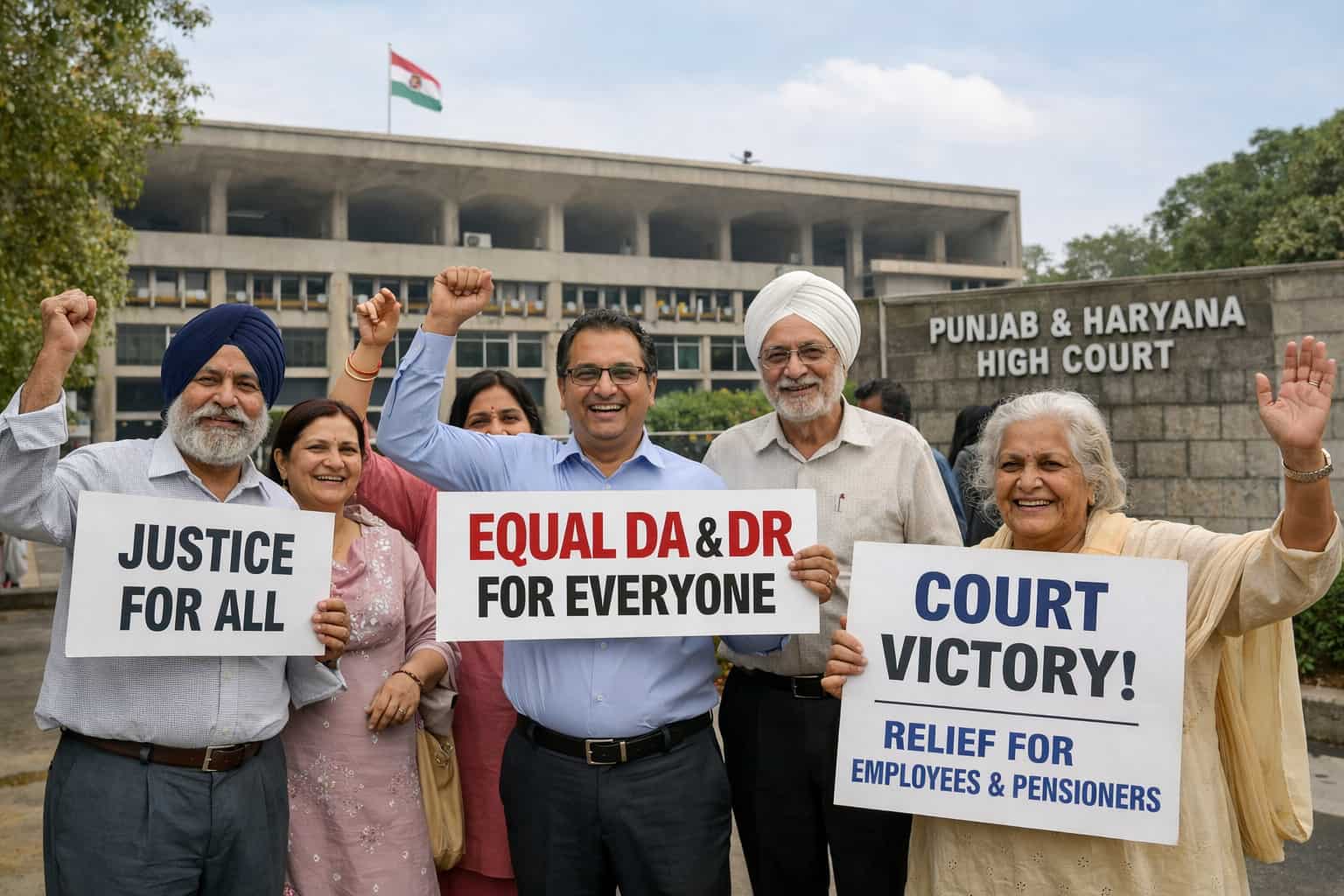
The debate over Dearness Allowance and Dearness Relief has taken a major turn, and this time the push has come from the judiciary. In an important ruling delivered on April 8, 2026, the Punjab and Haryana High Court held that DA and DR cannot be treated as optional or selectively managed benefits once the state has accepted the governing pay structure. The court directed Punjab and its corporations to release all pending DA and DR instalments at Central-pattern rates by June 30, 2026, and asked the Chief Secretary to ensure compliance.
That is why this judgment matters so much.
At one level, it is a Punjab case linked to employees and pensioners affected by delayed payments. But at a deeper level, it speaks to a much larger principle: inflation affects everyone, so relief from inflation cannot be granted in a selective or uneven manner. That simple logic sits at the heart of the court’s reasoning and explains why this verdict is now being discussed well beyond one state.
The dispute arose after Punjab accepted the recommendations of the 6th Punjab Pay Commission in 2021 and agreed to follow the Central government pattern for DA and DR. Even after that acceptance, several instalments remained unpaid or delayed. The controversy became sharper when the government introduced a February 18, 2025 liquidation plan that proposed phased payment of arrears by dividing pensioners into age-based categories. Older pensioners were to be paid earlier, while younger retirees were expected to wait longer.
This was not seen by the petitioners as a minor administrative adjustment.
For employees and pensioners, DA and DR are not symbolic benefits. They are part of the income support structure meant to protect purchasing power against rising prices. When inflation pushes up the cost of essentials like food, healthcare, transport and housing, DA for employees and DR for pensioners act as a buffer. If that buffer is delayed, reduced or applied inconsistently, the financial burden shifts directly onto households.
That is exactly why the legal challenge gained strength.
Before the court, the petitioners argued that once the state had accepted the pay commission structure and the Central pattern, it could not then selectively slow down, stagger or dilute the benefit for some while extending it to others. They also challenged the age-based classification among pensioners, arguing that all pensioners form one class and cannot be split into separate groups for delayed settlement of dues that are already acknowledged as payable.
The High Court agreed in strong terms.
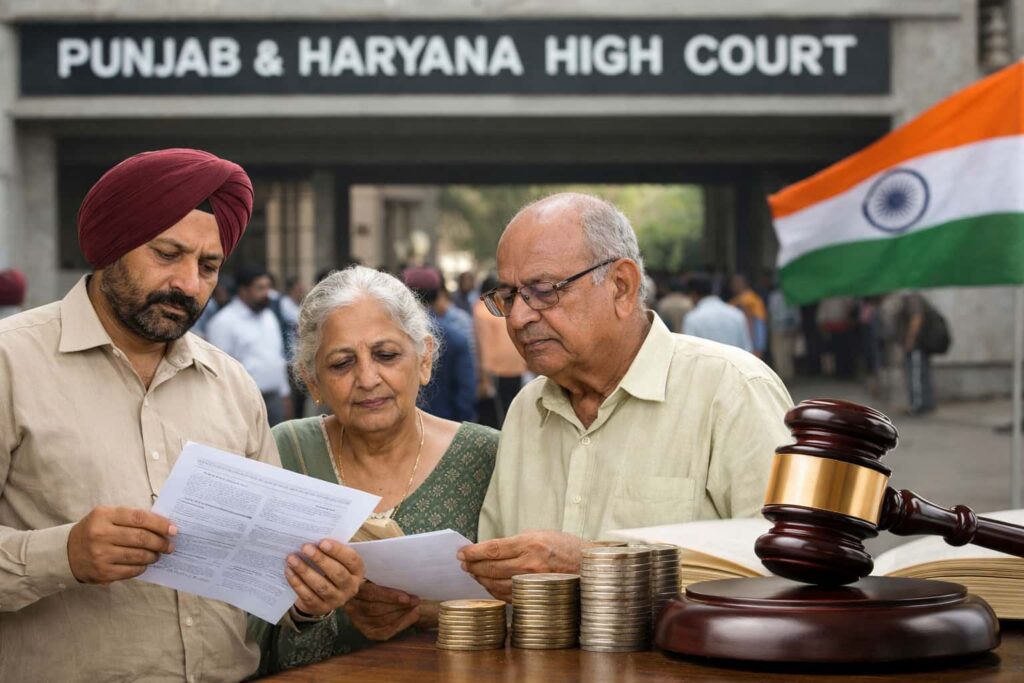
Justice Harpreet Singh Brar made it clear that DA and DR are not discretionary favours. The ruling treated them as enforceable entitlements linked to salary and pension structures. The court also rejected the argument that these matters were pure policy issues beyond judicial scrutiny. It held that courts can step in when policy becomes arbitrary or violates constitutional guarantees, especially equality principles under Articles 14, 16 and 21.
One of the most important observations in the judgment concerns the logic of inflation itself.
The court noted, in substance, that inflation does not operate differently for different categories of pensioners. It affects everyone. If the state recognizes that dearness compensation is necessary, then it cannot create artificial distinctions in deciding who gets it first and who must wait for years. This is what makes the ruling powerful. It shifts the conversation from administrative convenience to constitutional fairness.
The Punjab government had cited financial constraints, a defence often raised in such disputes. But the court did not accept that financial hardship could become a blanket excuse for withholding or postponing DA and DR. It held that a welfare state cannot invoke lack of funds to justify unequal treatment in the release of benefits it has already accepted as due. In other words, the government may face fiscal pressure, but that pressure does not give it the right to create discriminatory payment structures.
This part of the ruling will likely have the widest ripple effect.
Across India, DA and DR have often become flashpoints during periods of financial stress. Governments have delayed instalments, frozen arrears or changed release patterns. But what makes the Punjab and Haryana High Court verdict significant is that it clearly separates delay caused by administration from discrimination caused by selective implementation. The judgment sends a message that once a framework is accepted, the state must follow it fairly and consistently.
Another major feature of the ruling is its broad applicability.
The court said the judgment would operate in rem, which means the benefit is not confined only to the petitioners who went to court. It extends to all similarly placed employees and pensioners. That is a major relief point because it prevents the system from forcing every affected individual to file a separate petition simply to receive what is already recognized as due.
The timeline given by the court is also important.
Punjab and its corporations have been directed to release all pending DA and DR instalments at Central-pattern rates by June 30, 2026. The Chief Secretary has also been asked to ensure compliance and file an affidavit by July 2, 2026. That means this is no longer an open-ended administrative promise. It is a court-monitored obligation with a specific deadline.
For employees and pensioners, the financial value of the order is obvious.
Pending DA and DR do not remain just numbers on paper. Over time, delayed instalments become a serious pressure point for families already managing inflation. Pensioners, in particular, often feel the impact more sharply because their monthly budgeting is tighter and medical expenses can be unpredictable. A delayed inflation-linked component may look technical in a file, but in real life it can affect medicine bills, household purchases and day-to-day financial stability. That is why this judgment has been welcomed not just as a legal correction but as a practical financial safeguard.
The wider policy relevance is equally clear.
With the 8th Pay Commission process already underway, every legal development related to salary protection, pension fairness and inflation compensation is being watched carefully by employees’ unions and pensioner bodies. This ruling does not automatically rewrite national policy, but it strengthens a larger principle that governments ignore at their own risk: compensation tied to inflation cannot be treated casually, selectively or inconsistently after formal acceptance of the framework.
For unions and associations, this order becomes a strong reference point.
For governments, it is a warning that financial management cannot come at the cost of equal treatment. And for ordinary employees and pensioners, it offers something even more valuable than arrears: clarity. The court has drawn a line and said that administrative flexibility has limits. Once those limits cross into discrimination, the Constitution steps in.
The immediate focus now will be on implementation.
If Punjab complies fully within the court’s timeline, the judgment will bring long-awaited relief to a large number of employees and pensioners. If delays continue, the matter could deepen into a bigger confrontation over compliance. Either way, the decision has already changed the tone of the DA and DR debate. It has turned a routine benefits dispute into a larger statement on equality, accountability and financial justice.
That is the real takeaway from this ruling.
The Punjab and Haryana High Court has reminded governments of a basic truth: the cost of living rises without discrimination, and the relief meant to offset that burden must be delivered on the same principle. In a period when inflation continues to shape family budgets across the country, that message is both timely and powerful. This is not just a judgment on arrears. It is a reaffirmation that fairness cannot be selective when the hardship is universal.


Leave a Reply