


Every pay commission is remembered for its final recommendations. But what often goes unnoticed is the phase where those recommendations actually begin to take shape.
For the 8th Pay Commission, that phase is happening right now.
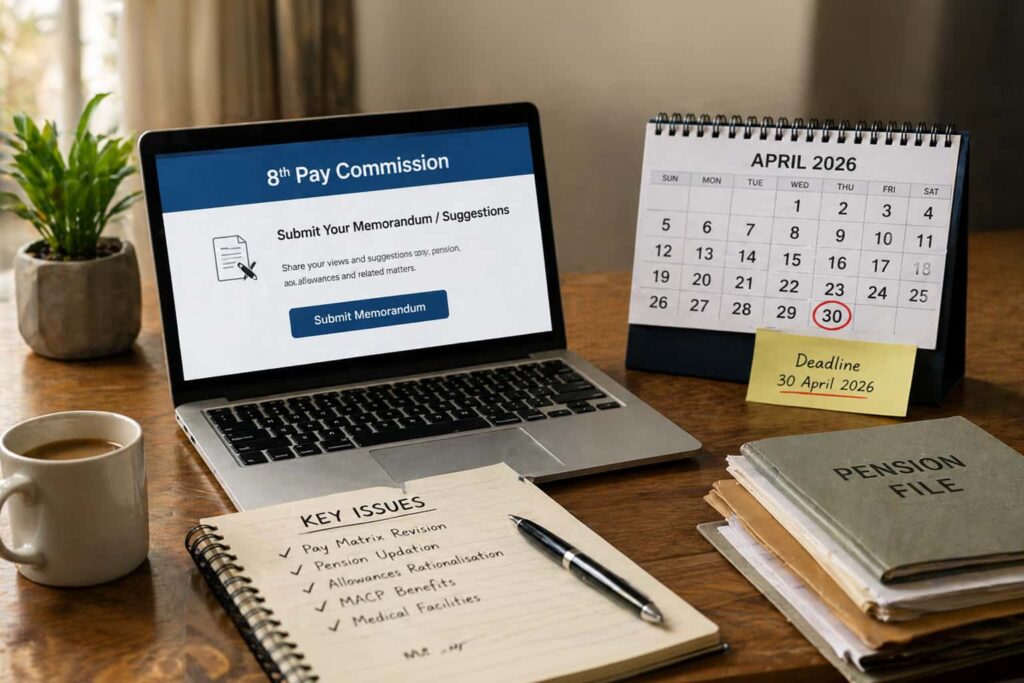
It is not happening in Parliament debates or public announcements. It is happening silently through the submissions being filed on the official portal. This is where the real groundwork is being laid, long before any final numbers or decisions are announced.

Understanding where the real process begins
Most people associate a pay commission with outcomes like salary revision, pension increases, or fitment factor changes. But the truth is, these outcomes are not created in isolation.
They are built on inputs.
The Commission studies patterns, identifies recurring concerns, and prioritises issues based on what is formally presented to it. Without structured inputs, even genuine concerns can fail to gain traction.
This makes the submission phase one of the most critical parts of the entire cycle.
Why this phase matters more than it appears?
At first glance, submitting a memorandum may seem like a routine step. But in reality, it plays a much bigger role.
The Commission does not rely on assumptions or public sentiment alone. It relies on documented evidence. Each submission becomes part of a larger database that is analysed to understand what employees and pensioners are actually facing.
If an issue appears repeatedly in this data, it signals importance. If it does not appear enough, it risks being seen as isolated or less significant.
This is how priorities are quietly decided.
From scattered complaints to structured evidence
In earlier years, many concerns remained scattered across forums, letters, and informal discussions. Today, the process is far more organised.
The portal has effectively turned individual concerns into measurable data points. This shift is important because it brings clarity to the decision-making process.
Instead of relying on perception, the Commission can now see trends backed by actual submissions. This improves transparency, but it also increases responsibility on individuals to ensure their issues are properly recorded.
The difference between being affected and being counted
There is an important distinction that often goes unnoticed.
You can be affected by an issue, but unless it is formally submitted, you may not be counted in the decision-making process.
This is where many critical concerns lose their impact. Not because they are small, but because they are not visible in the official dataset.
In a system driven by analysis, visibility matters as much as validity.
What kind of inputs create real impact?
Not all submissions carry the same weight. The ones that stand out usually have three things in common.
They are specific, they are relevant, and they offer clarity.
For instance, instead of broadly stating dissatisfaction, a strong submission explains the exact issue, identifies who is affected, and highlights the gap in the current system.
Whether it is related to pension disparity, promotion delays, allowance inconsistencies, or medical benefits, clarity makes it easier for the Commission to evaluate and act.
Why timing can influence outcomes?
The timing of your submission is equally important.
The current window is when the Commission is actively collecting and analysing inputs. This is the stage where the direction is still flexible.
Once this phase closes, the process gradually moves towards consolidation and drafting. At that point, adding new concerns becomes more difficult, and their influence may reduce.
This is why early participation often carries more weight than late representation.
The collective power of repeated issues
One submission can highlight a problem. Multiple submissions can establish it as a priority.
When the same issue is reported by a large number of people across different regions or departments, it creates a pattern. And patterns are what drive policy attention.
This is particularly important for issues that may not seem large individually but affect a significant number of people collectively.
Consistency across submissions strengthens the case.
The role of individuals alongside associations
Associations and unions continue to play an important role in representing broader demands. However, they cannot capture every individual experience.
Personal submissions add depth to the overall picture. They highlight variations, edge cases, and practical challenges that may not be fully covered in collective memorandums.
This combination of collective representation and individual input creates a more complete and balanced dataset.
Addressing the challenge of accessibility
While the digital submission process is efficient, it is not equally accessible to everyone.
Many pensioners and senior citizens may find it difficult to navigate online systems. This creates a risk where some of the most experienced voices remain unheard.
Awareness and support become essential here. Helping others submit their concerns can ensure that the process remains inclusive and representative.
What this means for the final recommendations?
The final recommendations of the 8th Pay Commission will not emerge suddenly. They will be shaped gradually through the inputs being received now.
Every submission contributes to a larger narrative. It helps the Commission understand not just what the issues are, but how widespread and urgent they are.
This is why participation at this stage is so important.
A quiet process with long-term impact
There are moments in every policy cycle that do not attract attention but carry long-term consequences. This is one of those moments.
The submission window may not make headlines, but it is influencing decisions that could affect salaries, pensions, and financial stability for years.
A simple step that carries weight
The process itself is straightforward.
Access the official portal, write your issue clearly, and submit it within the given timeline. Keep your submission focused and relevant.
It may feel like a small step, but in a structured system, small steps often create the biggest impact.
Because in the end, policies are not just shaped by discussions. They are shaped by what gets formally recorded and analysed.



Leave a Reply