

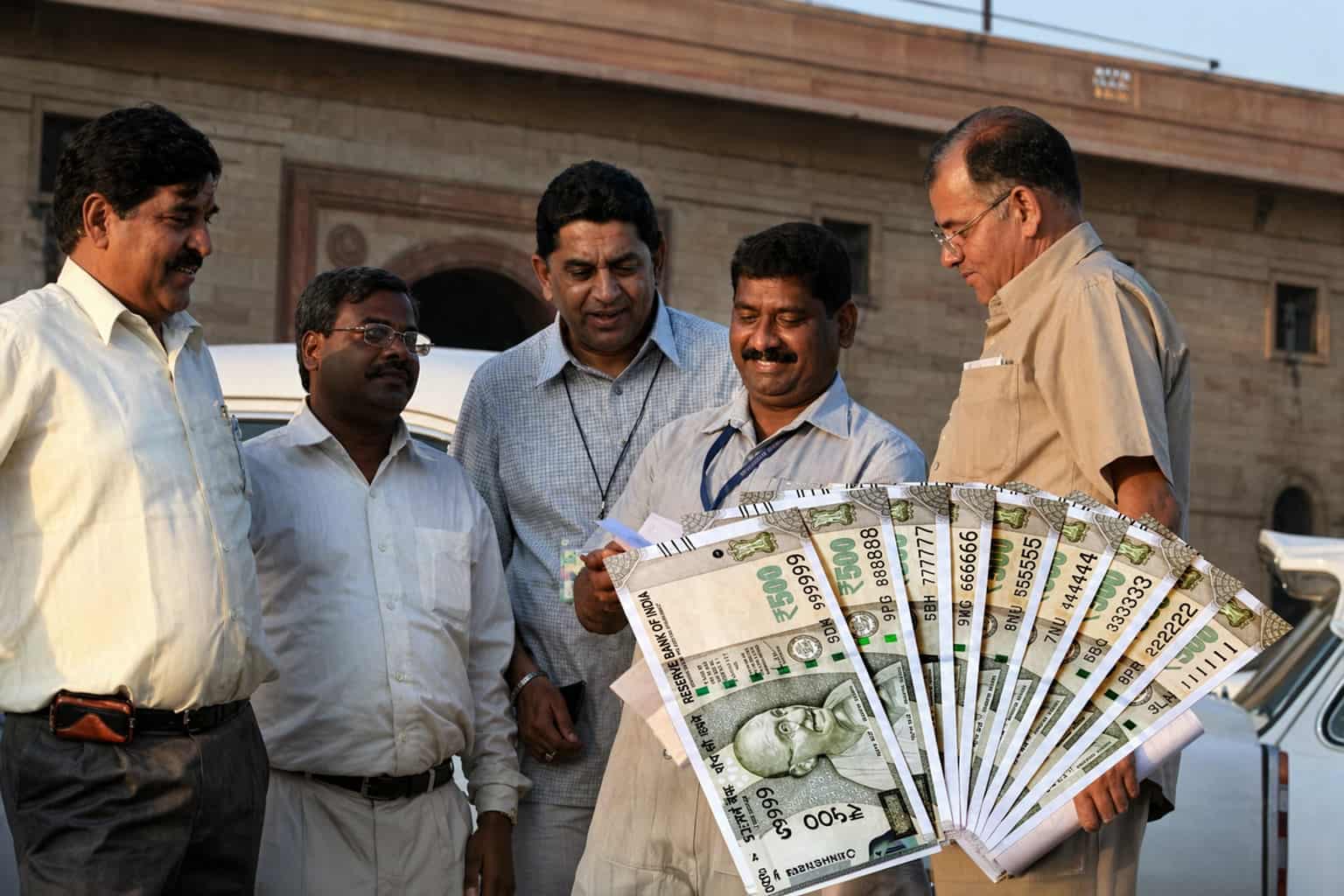
When the 8th Pay Commission is discussed in employee circles, the spotlight usually falls on the big headline topics. People want to know what may happen to minimum pay, what fitment factor could be considered, whether pensions may rise meaningfully, and how allowances could change. These are all important questions. But beneath those headline issues lies another subject that deserves far more attention than it is getting right now: gratuity.

For many serving employees, gratuity is not just a technical retirement term. It is one of the first major financial cushions available at the point of retirement. It helps bridge the difficult transition from monthly salary to post-retirement life. It can support medical expenses, debt repayment, children’s responsibilities, home-related needs, and the general uncertainty that often comes with the first few years after service.
That is why gratuity should not be seen as a side issue in the 8th Pay Commission debate. It may become one of the most practical measures of how seriously retirement dignity is being addressed.
The reason this issue matters so much is simple. A monthly pension provides continuity, but gratuity provides immediate strength. It is the amount that often helps a retiring employee settle financially at the most sensitive moment. Retirement is not only an emotional shift. It is also a financial adjustment. Household patterns change, salary stops, planning pressure increases, and in many cases, family responsibilities continue. At exactly such a stage, gratuity becomes more than a benefit. It becomes a stabiliser.
That is why the 8th Pay Commission debate should not remain limited to salary tables alone.
The current ceiling is an important starting point. The maximum gratuity limit for central government employees was enhanced from ₹20 lakh to ₹25 lakh after Dearness Allowance crossed 50 percent, with effect from 1 January 2024. That is the present confirmed position. But the real question is what happens next. If the 8th Pay Commission recommends a revised pay structure, and if basic pay rises significantly in the coming cycle, then the logic of retirement benefits will naturally return to the centre of the discussion.
Employees will ask a very practical question: if salary and pay matrix are being revised for the next decade, should gratuity also be revised to remain meaningful for the same period?
That question is not unreasonable. It is, in fact, necessary.
Inflation has changed retirement reality in a major way. Medical treatment is more expensive. Daily living costs are higher. Support for dependents often continues beyond retirement. Many employees also retire with unfinished family responsibilities, especially linked to education, healthcare, and housing. In such an environment, gratuity cannot be viewed only as a fixed rule-based payout. It must also be viewed as a retirement protection tool.
This is why a future discussion around gratuity under the 8th Pay Commission is likely to become much more serious.

Another reason the issue has become more important is the changing pension landscape. The retirement experience of an employee under the old pension structure is not identical to that of someone under the National Pension System or the Unified Pension Scheme framework. Monthly post-retirement confidence can vary depending on the pension route, market-linked outcomes, and overall benefit structure. In that situation, gratuity gains even more importance as a relatively direct and immediate retirement benefit.
For many employees, especially those trying to understand the long-term meaning of retirement security, gratuity is one of the few elements that feels tangible.
That is why the 8th Pay Commission may eventually have to look at gratuity not merely as a legacy benefit, but as part of a broader retirement security package.
This is especially relevant for employees nearing retirement around the 8th CPC implementation period. A person retiring before a revised pay structure comes into effect can face a very different financial outcome from someone retiring after it. Changes in pay fixation, pension calculation, gratuity ceiling, commutation value and other linked benefits can create a significant difference in post-retirement stability. For such employees, the issue is not theoretical. It can directly affect how secure or strained retirement feels.
The matter becomes even more sensitive when we consider defence personnel.
For members of the armed forces, retirement often comes earlier than in many civilian roles because of the rank structure, service conditions and career framework. That means a large number of ex-servicemen step into retired life at a stage when family responsibilities are still active. Children’s education may still be ongoing. Health and relocation expenses may be present. A second career may or may not begin immediately. In such a situation, gratuity is not simply one retirement component among many. It is part of the basic financial foundation with which many defence families rebuild civilian life.
This is why any conversation about 8th Pay Commission retirement benefits must include defence realities clearly and separately.
It is also important to remain careful at this stage. No new gratuity ceiling under the 8th Pay Commission has been officially approved. No final recommendation has been issued. That means any claim that gratuity will definitely rise to a fixed new amount should be treated cautiously unless an official order confirms it. The sensible position right now is not to assume a revision, but to recognise that gratuity is one of the issues that deserves strong and structured attention before the Commission finalises its recommendations.
That is where the memorandum process becomes important.
Employees, pensioners, ex-servicemen and associations should not discuss gratuity only in general terms. If they believe the present ceiling or formula needs review, they should explain why. A good submission should not simply say that gratuity must increase. It should show how rising living costs have changed retirement needs. It should explain whether the current ceiling is sufficient in the next pay cycle. It should raise questions of parity across pension structures. It should highlight whether the formula remains adequate for long-serving employees and those retiring under special service conditions.
In other words, the issue should be presented as part of a larger retirement logic.
There are several practical questions that can be raised in that context. Should gratuity continue to move automatically with Dearness Allowance-linked triggers? Should a revised 8th CPC pay structure lead to a fresh review of the gratuity ceiling? Should the relationship between gratuity and retirement timing be examined more carefully? Should employees under different pension frameworks receive stronger clarity and parity in gratuity protection? Should defence personnel and those who retire early due to service conditions receive a more realistic treatment?
These are not dramatic questions. They are everyday retirement questions.
And that is exactly why the issue matters so much.
For many government employees, the 8th Pay Commission will define not only active service income but also the quality of post-service life. A strong retirement package creates confidence. A weak or outdated one creates insecurity. Salary revision may dominate headlines, but retirement benefits often decide how the reform is actually felt by families.
That is why gratuity could become the silent test of how balanced the 8th Pay Commission really is.
If the Commission wants to create a framework that looks beyond short-term excitement and addresses long-term financial dignity, then gratuity deserves a serious place in the conversation. It is not a bonus. It is not a minor administrative benefit. It is one of the clearest markers of how the system values long years of public service.
So for employees close to retirement, for pension-focused readers, and for defence families planning ahead, the message is simple. Watch the pay matrix, yes. Watch fitment factor, yes. But do not ignore gratuity.
Because when the time comes to judge whether the 8th Pay Commission truly strengthened retirement security, gratuity may turn out to be one of the most important answers.



Leave a Reply