


For central government employees and pensioners, the March 2026 CPI-IW release matters because it is not just another inflation update. It is one of the key inputs used in the Dearness Allowance and Dearness Relief system. The Labour Bureau’s March 2026 release says the All-India CPI-IW increased by 0.6 points, moving from 148.5 in February 2026 to 149.1 in March 2026. The same release says year-on-year inflation for industrial workers rose to 4.27%, compared with 2.95% in March 2025. That combination, a monthly rise and a higher annual inflation reading, is exactly why this update is drawing so much attention.
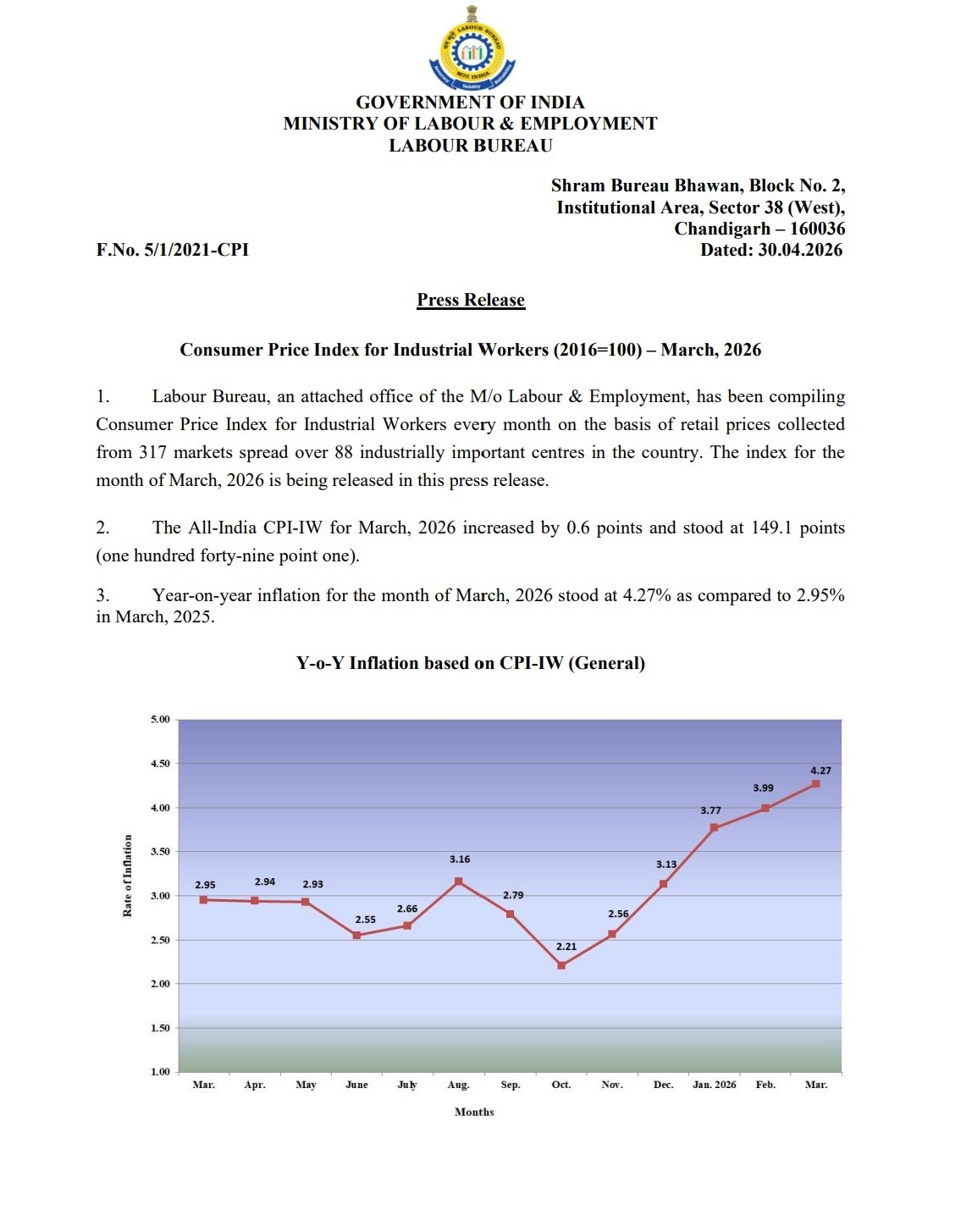
The importance of this number becomes clearer when seen against the current DA/DR position. The Union Cabinet approved a 2 percentage point increase in DA and DR from 58% to 60%, effective 1 January 2026, and the Department of Expenditure issued the formal Office Memorandum on 22 April 2026. That means employees and pensioners are now looking ahead to the next revision cycle, and March 2026 has become one of the most closely watched data points in that process.
What makes March especially useful is that it sharpens the early direction of the July 2026 calculation. As The Economic Times explains, DA is calculated on the basis of the 12-month average of AICPI-IW, after linking the newer 2016-base series to the older calculation method. In practical terms, the July 2026 revision will depend on the full 12-month average running up to June 2026, so March does not decide the final result by itself. But it does strengthen the running average at a stage when each monthly movement matters.
This is also why the figure 61.93% is being discussed in employee and pensioner circles. It should be understood only as an early trend figure, not as the final DA or DR rate. Public calculators and discussions are now talking about a level just under 62%, but that is still a projection based on incomplete data, not an official decision of the government. The remaining CPI-IW readings for April, May, and June 2026 will still shape the final outcome.
That distinction is important because people often confuse a running trend with a confirmed announcement. A projection can move up or down as new data arrives. A final DA/DR rate comes only after the full calculation base is available and the government formally approves it. Right now, March has made the trend look firmer, but it has not closed the calculation. So the smarter reading is this: the signal has improved, but the decision is still pending.
The bigger reason this matters is cost of living. CPI-IW is not followed so closely because employees enjoy tracking index numbers. It matters because it reflects pressure on everyday household spending. When the Labour Bureau reports a higher CPI-IW and a higher year-on-year inflation rate for industrial workers, it feeds directly into the case that salaries and pensions need protection against rising expenses. For serving employees, that protection comes through DA. For pensioners, it comes through DR. In both cases, the purpose is the same: preventing fixed income from losing value as prices rise.

That is also why this CPI-IW movement links naturally with the broader 8th Pay Commission debate. The 8th CPC is not deciding the July 2026 DA/DR rate, but it is the forum where the larger questions of pay revision, pension protection, allowances, and cost-of-living adequacy are being argued. The official 8th CPC memorandum page shows that the Commission is inviting representations from employees, pensioners, defence personnel, service associations, unions and ministries, with the deadline now extended to 31 May 2026. It also makes clear that submissions are online only. In that environment, inflation-linked data such as CPI-IW becomes useful evidence in arguing why future pay and pension structures should not be treated as routine administrative revisions.
Seen that way, March 2026 has done two things at once. First, it has given employees and pensioners a stronger early signal for the July 2026 DA/DR calculation. Second, it has added fresh weight to the larger argument that inflation pressure remains real and that salary and pension policy cannot ignore everyday living costs. That is why this update feels more important than a normal monthly index release. It is speaking to both the short-term DA/DR discussion and the longer-term 8th CPC cost-of-living conversation.
The practical takeaway is simple. March 2026 CPI-IW has improved the tone of the July 2026 DA/DR outlook, and an early trend around 61.93%, or roughly 62%, is now being discussed in public calculators and employee circles. But that number is still only a running estimate. The final result will depend on the next three CPI-IW releases and the government’s later approval process. Until then, March should be treated as a positive push, not a final verdict.


Leave a Reply