


The 8th Pay Commission debate has produced many strong demands from employee bodies, teachers’ groups, pension forums and service associations. Among the more widely discussed ones are two sensitive demands: an option for NPS subscribers to move toward Old Pension Scheme-like protection, and an increase in retirement age to 65 for teachers. These ideas naturally draw attention because they touch two very emotional areas of public service life, retirement security and career span.
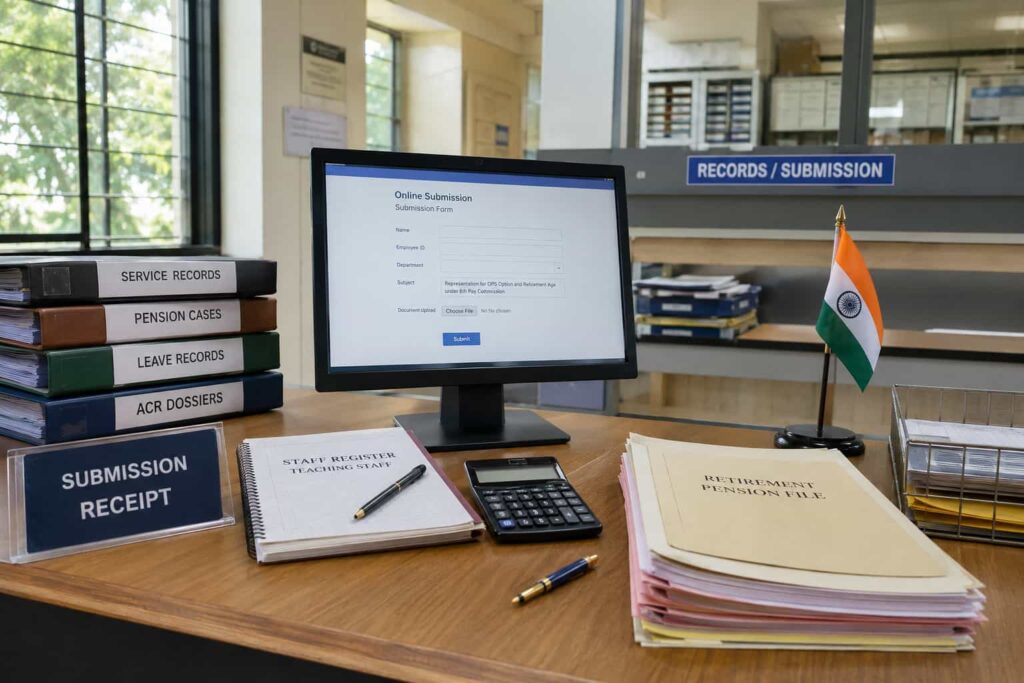
But when we move from debate to official process, the picture becomes much more practical.
On the publicly visible pages of the official 8th CPC website, there is no separate public PDF, order, minutes note or dedicated online form specifically naming the AINPSEF demands on OPS option for NPS subscribers or retirement age 65 for teachers. What the website does clearly show is the broader 8th CPC workflow: the Commission has been constituted, it is active, it is inviting structured representations, and it is also running appointment links for specific city interactions such as Hyderabad, Srinagar and Ladakh.
That distinction matters more than it may first appear.
A lot of employees assume that once a demand becomes widely discussed in media reports or employee circles, it has already entered the Commission’s core record. But the official site suggests a stricter reality. The 8CPC memorandum submission page says the Commission invites representations, memorandums and suggestions from a broad range of stakeholders including central government employees, defence forces personnel, pensioners, service associations, unions, ministries, departments, organisations and Union Territories. It also clearly says the last date for submissions is 31 May 2026, that all submissions must be made only through the specified online route, and that paper copies, PDFs and emails are not being considered.
This means the real strength of any demand now depends on whether it is inside the official process, not only outside it.
That is the key lesson for those following the OPS and teacher-retirement-age debate. A public demand can create momentum. It can influence discussion. It can help employee unions frame their position. But if the official website is not separately displaying that specific demand as a published document or dedicated form, then stakeholders should not assume it already has a privileged place in the system. The safer assumption is the opposite: if the issue matters, it should be formally submitted through the memorandum process while the window remains open.
This is where the topic becomes important for a wider audience.
The OPS option issue is not just a technical pension-policy argument. For many employees under NPS, it represents uncertainty about post-retirement income, family stability and long-term financial dignity. The teacher retirement age issue is also bigger than a service extension debate. For supporters, it involves continuity of educational experience, use of senior academic capacity and a rethinking of age-based exit in a system where expertise matters. Whether one agrees or disagrees with these demands, their importance is real. But importance alone does not guarantee formal consideration.
The 8th CPC process appears to be designed to reward structure.
The website shows a memorandum process for representations and a separate appointment page only for specified city visits. That appointment page is not a thematic channel for OPS, NPS, teachers or any one employee body. It is simply a procedural route for seeking meetings connected to named visits. In other words, it is not a substitute for filing the demand itself. First comes the structured submission. Only then, where relevant, comes the meeting route.
This is exactly why the current stage should be read carefully.

If readers are searching the official website hoping to find a dedicated page saying, in effect, “here is the official 8th CPC form for OPS option for NPS subscribers” or “here is the official teacher retirement age 65 proposal,” they are likely to be disappointed. The public site does not currently appear to present the issue in that narrow and direct way. Instead, it presents a general official mechanism through which such issues may be raised. That shifts the burden back to stakeholders themselves. If employee associations, teacher organisations or pension groups want these matters to be examined seriously, they need to formulate them clearly and place them properly before the Commission.
That makes this more a process story than a headline story.
For employees, the practical message is simple. Do not assume that a demand is safely inside the 8th CPC system merely because it is being discussed in media or social media. Check whether it exists on the official platform in a form the Commission is actually using. Right now, what is clearly visible is the general memorandum route. So if the issue is OPS option, teacher retirement age, pension security or service reform, the stronger path is to draft it carefully, support it with logic and use the official online channel before the deadline.
For associations, the lesson is even sharper.
This is the stage to move from slogan to submission. A strong memorandum should not only state the demand. It should explain who is affected, what problem the present structure creates, what change is being requested and why that change is justified in administrative, financial or social terms. For OPS-related demands, that may mean focusing on retirement security and pension predictability. For teacher-retirement-age demands, that may mean focusing on institutional continuity, experienced faculty retention and practical workforce needs. The Commission may or may not agree, but it can only properly examine what is clearly and formally placed before it. This is an inference from the design of the 8CPC process, which emphasises structured online representations.
So the real takeaway is not that the AINPSEF demands are unimportant. It is that the official 8th CPC website, at least on its publicly visible pages, is not treating them as a separately published category right now. That means the debate is still alive, but it must travel through the general memorandum route if stakeholders want it to carry official weight. In the 8th CPC era, that may be the most important difference of all: a demand becomes stronger not when it trends, but when it enters the record.


Leave a Reply