


When a government employee dies in service or is medically invalidated, the family is pushed into two crises at once. One is emotional, and the other is financial. The first cannot be solved by policy. The second is exactly why compassionate appointment exists. It is meant to support a dependent family that has suddenly lost its earning member and is facing real hardship.

But compassionate appointment has never been a simple sympathy-based process. The number of applicants is often larger than the vacancies available. Every case comes with pain. Every file carries a family story. That is why departments need a method to decide which family is in the greatest financial difficulty and should be given priority first.
That is where the Ministry of Defence’s revised 100-point merit system becomes important.
The Department of Personnel and Training, which is the nodal department for the Government of India’s compassionate appointment scheme, says the object of the scheme is to grant appointment on compassionate grounds to a dependent family member of a government servant who dies in harness or is retired on medical grounds, leaving the family in penury and without means of livelihood. The same DoPT document also extends the scheme to dependents of Armed Forces members who die during service, are killed in action, or are medically boarded out and found unfit for civil employment.
So the foundation of the scheme is welfare. But the revised defence-side process is now more structured.
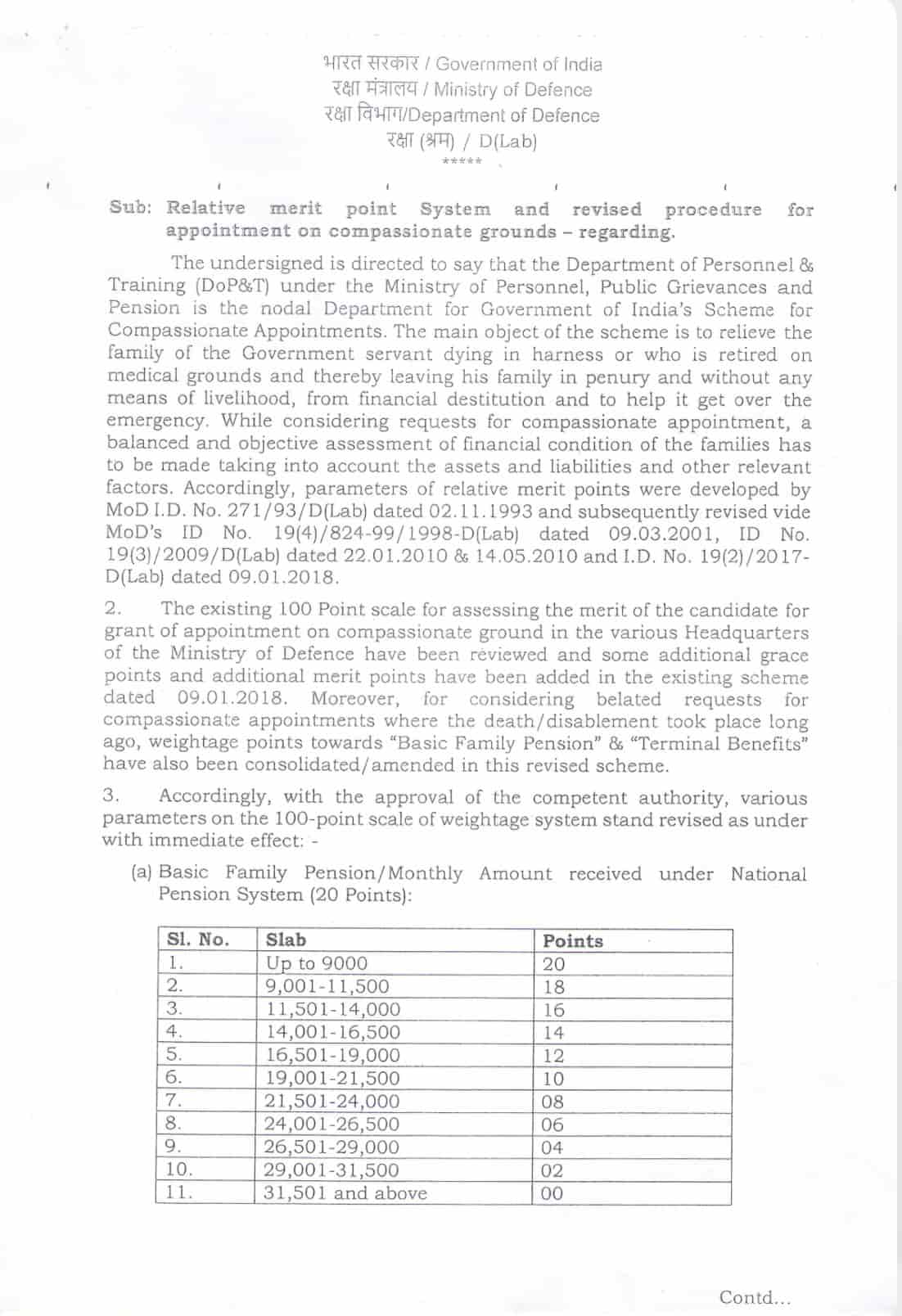
As reproduced by StaffNews from the Ministry of Defence order, the existing 100-point scale used in various MoD headquarters has been reviewed. The revised system adds extra grace points and extra merit points and also updates how older, belated cases are evaluated, especially under the heads of basic family pension and terminal benefits.
In practical language, this means one thing. Families can no longer depend on general verbal pleas alone. They must show their financial distress through documents, because every point in the assessment now matters.
The revised structure reportedly continues to assess hardship through clear heads such as family pension or monthly amount under NPS, lump sum benefits received after death, annual income from property or earning family members, value of assets, number of dependents, unmarried daughters, minor children and left-over service at the time of death or medical invalidation. Lower pension, lower lump sum support, lower outside income and greater dependency can mean a stronger score.
This is important because many families still do not understand why one compassionate appointment case moves faster while another remains pending. The answer is often not that one family’s tragedy matters more than another’s. It is that the system is trying to rank financial distress objectively.
For example, the revised MoD scale reportedly gives up to 20 points under the head of basic family pension or monthly amount under NPS, with lower slabs receiving higher points. It also gives up to 10 points for lump sum death-related receipts such as gratuity, provident fund balances, leave encashment, insurance and similar payments, again awarding more points where support is lower.
That creates a clear message for families. If the pension is low, if terminal benefits are limited, if there is no real support from property or from another earning member, and if there are more dependents to maintain, that hardship must be properly documented.
DoPT’s own scheme supports this balanced approach. It says compassionate appointment cannot be granted as a matter of course regardless of financial condition, and a balanced and objective assessment of the family’s financial position has to be made, taking into account assets, liabilities and other relevant factors.
This is also why the existence of an earning member does not automatically end the case. DoPT says that in deserving cases, even where there is already an earning member in the family, another dependent may still be considered, but only after examining the number of dependents, assets and liabilities, the income of that earning member and whether that person is actually supporting the family.
That sounds technical, but for families it is a practical warning. If there is an earning member, the authorities will look closely at whether the family is still in distress. So bank statements, dependency proof, household liabilities and income details become very important.
One of the biggest changes in the revised MoD framework, as reported, is the addition of grace points. StaffNews says additional points may be available in situations such as both parents having expired, the widow herself applying for compassionate appointment, or a dependent being differently abled.
This is a humane improvement because not every hardship can be captured by pension and income alone. A widow trying to support the household by herself, a differently abled dependent, or children who have lost both parents may face a more severe crisis than the raw income figures alone suggest.
Another important area is delayed applications. DoPT’s rules say compassionate appointment is meant to help a family through sudden financial distress, but cases may still be examined with care even where delay is involved. The revised MoD scheme, as reproduced by StaffNews, reportedly gives separate merit points depending on how late the application was filed after the death of the employee. Cases filed earlier receive higher points, while older delayed cases receive lower points.
That means old cases are not automatically closed, but they become harder to justify unless the family can still show continuing hardship.
The revised order also appears to introduce a more systematic tie-break method. Where two candidates get equal marks and both cannot be adjusted against the available vacancies, the tie is reportedly broken first through available income per dependent, then left-over service, then dependents with disability or unmarried daughters, and finally the age of the applicant.
For applicants, that matters because it makes the process more transparent. It also means that vague or incomplete documentation can hurt a deserving case even when the family is genuinely struggling.
That is the biggest takeaway from this update.
Compassionate appointment under the revised MoD system is becoming more transparent, but also more evidence-based. That is good for fairness, but it puts responsibility on the family to build a complete file. Death certificate or medical invalidation order, service details, pension papers, terminal benefit details, dependency certificate, income certificate, bank records, asset declaration, records of unmarried daughters, minor children, disability documents and acknowledgment of application all become important pieces of the case.
In the end, compassionate appointment is not about emotional storytelling alone. It is about proving financial distress in a system that now runs on relative merit points.
That is why families should not wait for informal advice, verbal assurances or incomplete submissions. Under this revised 100-point system, every document can affect the score, every missing paper can reduce clarity, and every point can make the difference between early relief and prolonged hardship.



Leave a Reply