


When most people hear about a military exercise, they imagine standard battlefield drills, marching contingents and tactical practice. Those things are certainly part of the picture. But some exercises carry a message that goes well beyond troop movement and training schedules. Exercise PRAGATI is one of those cases. On paper, it is a multinational military engagement. In strategic terms, it is a sign that India wants regional security partnerships to become more practical, more connected and more visible.
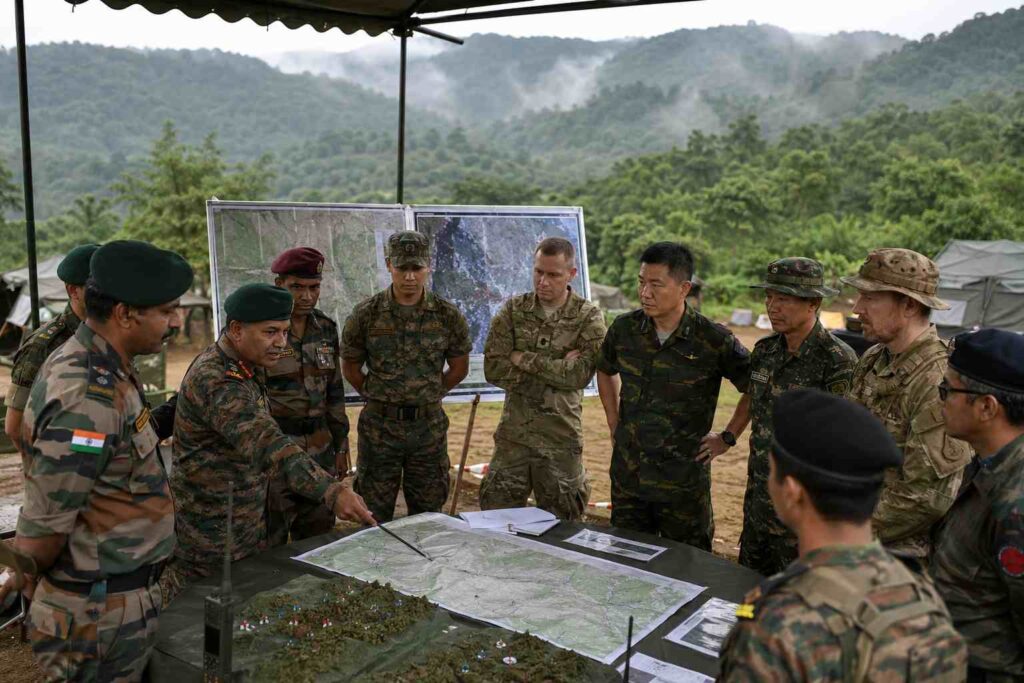
The Indian Army is set to host the inaugural edition of Exercise PRAGATI at the Foreign Training Node in Umroi, Meghalaya, from 18 May to 31 May 2026. DD News and The Times of India both report that military delegations from 11 friendly foreign countries will participate. DD News says the aim is to strengthen defence cooperation, improve interoperability and build mutual trust, while also describing the initiative as a shared commitment to collective security and regional stability.
That is what makes this event important. It is not just another entry in the military exercise calendar. It is a deliberate attempt to create one platform where multiple regional armies can learn together, train together and build familiarity together. India already runs several bilateral exercises with individual countries. But PRAGATI introduces a broader format. Instead of one army training with one partner at a time, it brings together a cluster of countries connected by geography, shared security concerns and regional strategic importance.
The name of the exercise itself explains the larger ambition. DD News reports that PRAGATI stands for Partnership of Regional Armies for Growth and Transformation in the Indian Ocean Region. That expansion is revealing. It shows the exercise is not being presented as a narrow tactical drill. It is being framed as part of a larger regional-security idea, one in which armies are expected to cooperate not only in emergencies but also in building long-term trust and shared readiness.
The reported list of participating countries also gives the exercise real geopolitical shape. The Times of India identifies Laos, Myanmar, Seychelles, Sri Lanka, Philippines, Nepal, Maldives, Malaysia, Vietnam, Cambodia and Bhutan as participating delegations. Drishti IAS groups them across India’s immediate neighbourhood, Southeast Asia and the Indian Ocean region. That matters because it mirrors the exact arc in which India has been trying to deepen strategic engagement for years. This is not an accidental collection of names. It is a map of India’s regional outreach.
This is also why the venue matters so much. Meghalaya is not just a scenic location for an exercise. By hosting PRAGATI in Umroi, India is quietly underlining the strategic relevance of the Northeast. Drishti IAS explicitly links the exercise to India’s Act East Policy, and that connection is important. The Northeast is not only a frontier region. It is also one of India’s key gateways toward Southeast Asia. Holding a multinational military engagement there sends a message that the region is central to India’s strategic imagination, not peripheral to it.
The training focus adds another layer of meaning. The Times of India reports that the exercise centres on counter-insurgency and counter-terrorism operations, while Drishti IAS says it is aimed at strengthening operational synergy and improving standardisation in tactical procedures, communications and joint strategies. That makes practical sense. Many countries in this wider region face difficult terrain, internal security pressures, hybrid threats or cross-border instability. Training together in these areas gives armies a chance to compare real methods, not just theory.
For ordinary readers, the simplest word to understand here is interoperability. It sounds technical, but the meaning is straightforward. If different militaries ever need to cooperate during a crisis, disaster response, peace-support operation or security contingency, they must already know how to communicate and function together. That kind of understanding cannot be built in one emergency meeting. It is built through repeated training, shared drills and professional contact. Exercises like PRAGATI help create that foundation.
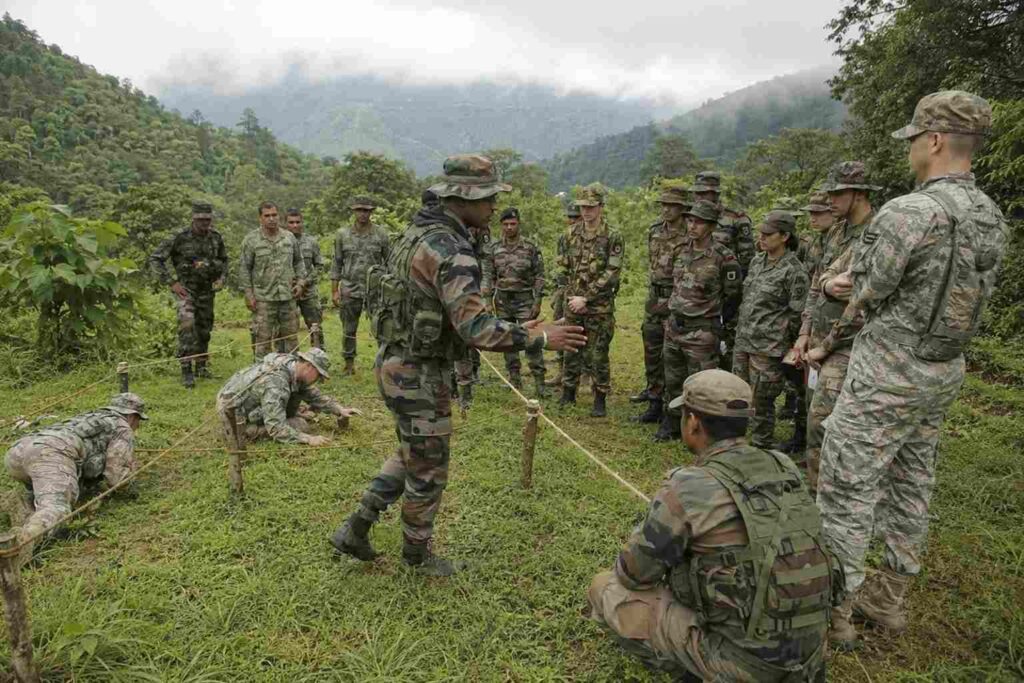
There is also a humanitarian dimension that should not be overlooked. Drishti IAS says the exercise is meant to improve coordination for Humanitarian Assistance and Disaster Relief, or HADR, in addition to its tactical themes. That is a major point because the wider region is repeatedly hit by floods, cyclones, landslides, earthquakes and other emergencies. In such situations, armies often become first responders because they have logistics, mobility and disciplined field structures. If regional militaries have already trained together, they are naturally better placed to cooperate during actual disasters.
Another reason PRAGATI matters is that it extends beyond pure field training. The Times of India reports that the exercise includes a two-day industry exposition, and a FICCI event page linked to the exercise also describes an industry exposition during Multilateral Joint Exercise Pragati-I 2026 at Umroi. That changes the nature of the event. It means PRAGATI is also becoming a platform for defence-industry outreach and military-technology visibility, not just troop-level interaction.
This matters because in modern defence diplomacy, countries do not only train together. They also watch what each other can build, integrate and deploy. A military exercise that includes an industry exposition becomes a place where operational cooperation and capability signalling meet. In India’s case, that fits neatly with the larger effort to project indigenous defence competence alongside strategic partnership-building. This is an inference from the exercise-plus-exposition format, but it is a highly reasonable one given the official and reported design of the event.
For the Indian Army itself, such an exercise also has professional value. Training with multiple foreign contingents creates exposure to different military habits, tactical approaches and field problem-solving methods. That may not always produce dramatic headlines, but it improves military learning. Strong armies do not improve only by training harder. They also improve by training with a wider range of serious partners and understanding how others think and operate.
In the end, Exercise PRAGATI matters because it brings several strategic ideas together in one place. It is about military training, but also about trust. It is about counter-insurgency and counter-terrorism, but also about regional diplomacy. It is about the Indian Army’s professionalism, but also about India’s larger regional posture. And by hosting it in Meghalaya, India is making a quiet but important statement that the Northeast is central to its future security partnerships. That is why PRAGATI should not be seen as just another military drill. It is a sign that India wants regional security to be shaped not only through official statements, but through practical military relationships built on familiarity, cooperation and shared readiness.



Leave a Reply