

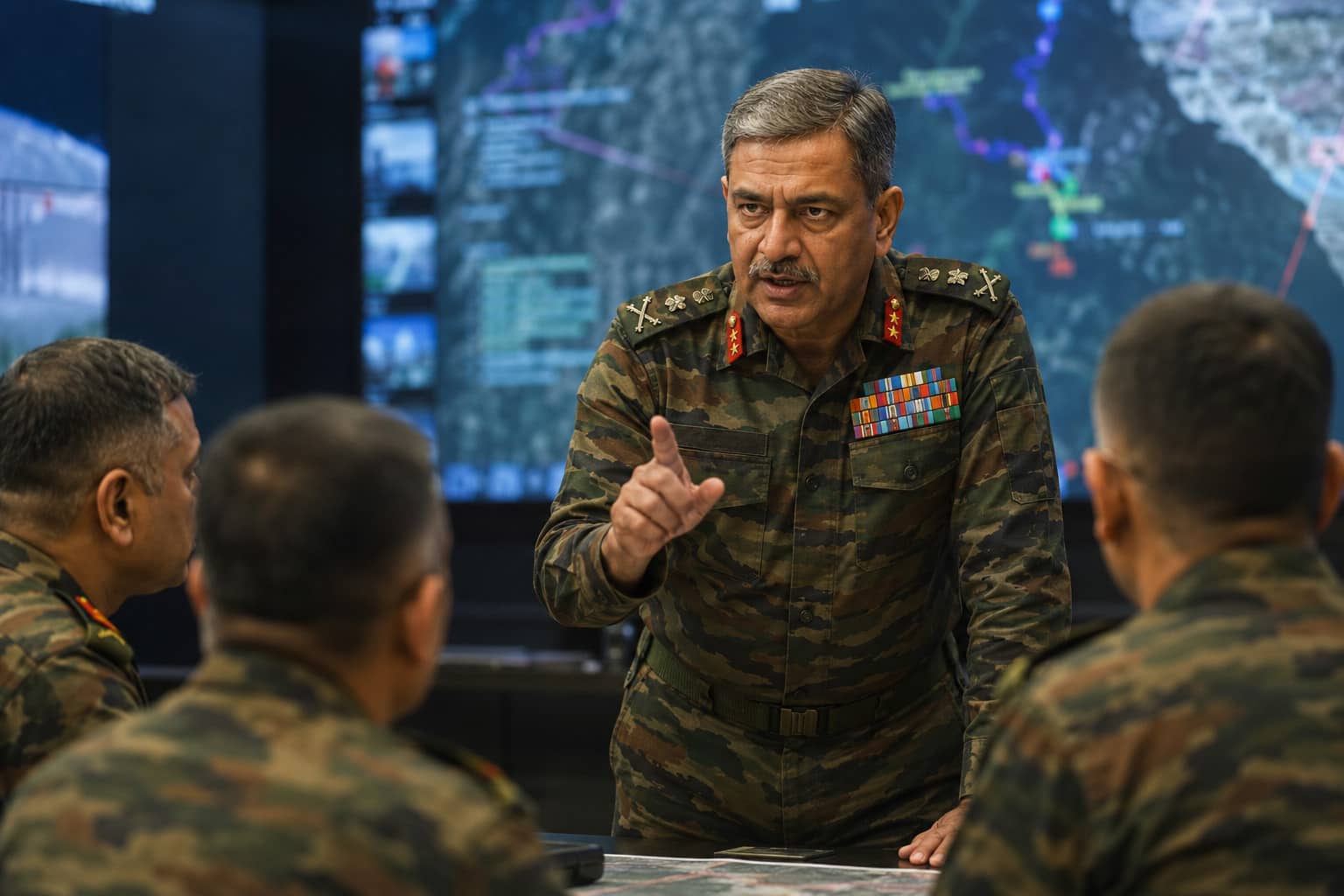
For years, India’s terrorism challenge often followed a familiar and frustrating pattern. A major attack would take place, national anger would rise, security agencies would respond, and diplomatic pressure would follow. The language would harden, evidence would be presented, and global attention would briefly turn towards the source of the threat. But after some time, the cycle would return. That repetitive pattern created a deeper problem. It risked making terrorism look like a manageable disturbance rather than a strategic red line.
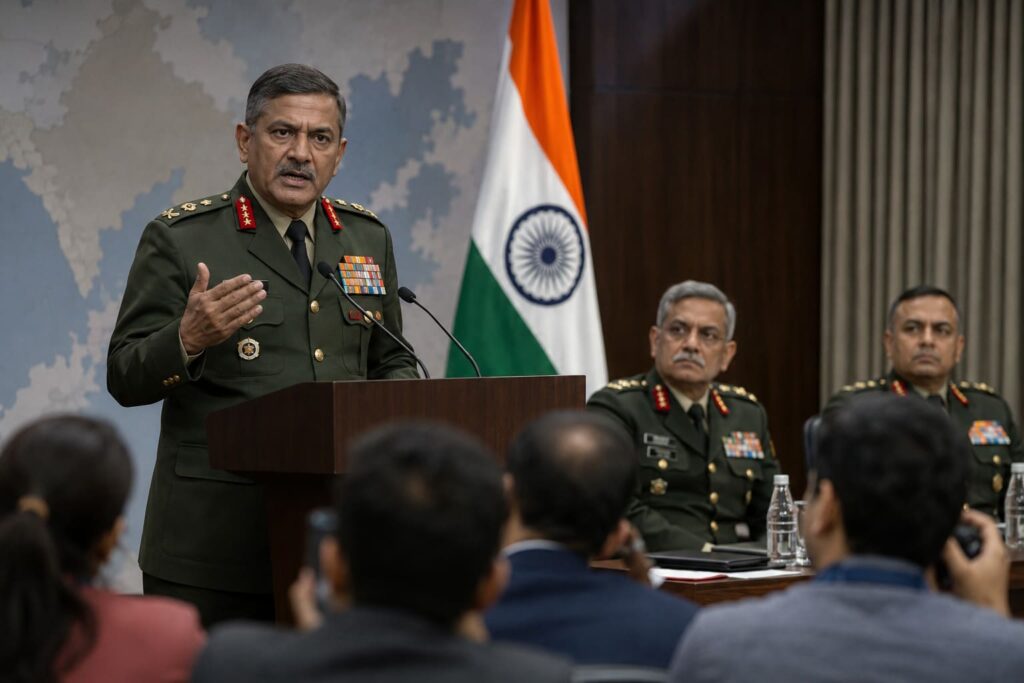
That is why the Army Chief’s latest warning matters so much.
General Upendra Dwivedi’s remarks were not important only because they were forceful. They were important because of what they suggested about India’s evolving security mindset. The message was clear: if terrorism continues to be used against India, the response will not remain limited to the older template of outrage, warning and patience. India wants the other side to understand that support for terror can no longer be seen as a low-risk strategy.
This is the larger strategic meaning behind the statement.
At one level, the Army Chief was answering a public question linked to conditions similar to those that existed before Operation Sindoor. But the deeper signal was not about one incident alone. It was about how India now wants terrorism to be viewed in the broader national security framework. The country is increasingly treating cross-border terror not as an isolated law-and-order challenge, but as a form of hostile strategic action. That changes the terms of the conversation.
And when the terms of the conversation change, so do the expectations of response.
For a long time, Pakistan’s use of terrorism as an instrument of pressure appeared to function on one assumption: that deniability, proxy distance and diplomatic complexity would help keep the costs limited. In other words, the attack could be serious, but the consequences could still remain manageable. India’s recent posture appears designed to challenge exactly that assumption. The message now is that the comfort of operating through proxies cannot be taken for granted forever.
That is why the Army Chief’s words should be read as a deterrence message, not just a warning line.
Deterrence is often misunderstood in public discussion. Many people think deterrence starts only after a response is delivered. In reality, deterrence begins much earlier. It begins when one side makes the other side believe that the next provocation will carry a serious and possibly unpredictable cost. The purpose is not only punishment after an event. The purpose is to shape behaviour before the next event happens.
India’s latest messaging fits that logic.
The country is not only saying that terrorism is unacceptable. It is also saying that the old gap between terrorism and visible consequence is narrowing. That is the important shift. If the adversary believes that a terror strike will no longer be absorbed into a routine cycle of protest and restraint, then the strategic value of using terror begins to weaken. That is how deterrence works at its most basic level.
This is where the reference point of Operation Sindoor becomes significant.
Whether one sees it as a security milestone, a psychological turning point or a doctrinal signal, Operation Sindoor has clearly entered India’s public security memory as more than just one operation. It represents a broader willingness to show that terrorism and consequence can be linked more directly than before. The Army Chief’s statement gains extra meaning because it came in that shadow. It was not an isolated remark. It was part of a continuing effort to remind both Pakistan and the Indian public that India’s threshold of tolerance has changed.
That does not mean India is abandoning restraint.
In fact, the stronger interpretation is the opposite. India appears to be redefining restraint itself. The older model of restraint was often seen by critics as patience without sufficient consequence. The newer model being projected is one of controlled firmness. It suggests that India may still act with calculation, but it does not want that calculation to be mistaken for passivity. This is an important distinction. A state can be measured without being weak. It can avoid recklessness without accepting endless provocation.
That is what makes the current messaging more serious than a headline-driven reaction.
A statement from the Army Chief carries institutional weight because it comes from someone whose office is linked with actual preparedness, actual capability and real operational credibility. Strong language from such a position is not meant only to energise an audience. It is meant to shape expectations. It tells adversaries that the warning is being spoken from within a structure that can act if required. That is what gives such remarks strategic value.
For Indian citizens, the importance of this shift should be understood clearly.
This is not just about Pakistan hearing a harder line. It is also about India defining its own doctrine more openly. The public is being told that terrorism is no longer viewed merely as a painful but repetitive security burden. It is increasingly being framed as an unacceptable trigger that can invite broader consequences. That matters because national morale is also shaped by the belief that sacrifice, loss and repeated targeting will not be met only with symbolic language.
This has a particular emotional meaning for soldiers and their families.
For those serving in sensitive areas, terrorism is not an abstract policy issue. It is tied to patrol risk, operational pressure, local instability and the constant possibility of violence. When national leadership speaks more clearly about consequence and deterrence, it carries morale value inside the system. It tells the soldier that the burden he carries is being recognised within a stronger doctrine of response, not just within a language of endurance.
At the same time, responsible analysis must stay disciplined.
A harder message does not automatically mean immediate escalation. Nor should every strong military statement be treated as proof that war is imminent. That is not how serious statecraft works. Strategic signalling is most effective when it creates uncertainty in the mind of the adversary while preserving control in the hands of the state. India’s current posture appears to be moving in exactly that direction. It wants the adversary to worry more, but it does not want to surrender the advantage of deliberate choice.
That is a mature form of pressure.
There is also a communication battle involved here. In the modern security environment, conflict is shaped not only by action on the ground but by interpretation afterward. Narrative matters. Messaging matters. If India wants to establish that terrorism will now be judged through a harder strategic lens, then statements from top military leadership become part of that larger signalling architecture. They help define what the country sees as intolerable and how it wants future provocations to be understood.
So what is the plain meaning of the Army Chief’s latest warning?
It means India is trying to alter Pakistan’s risk calculation. It means the country wants terrorism to look more expensive, more dangerous and less strategically useful than before. It means that the old assumption of limited cost is being challenged directly. And it means India is increasingly presenting deterrence not as a slogan, but as a practical part of its security doctrine.
That is why this moment matters far beyond one public statement.
General Upendra Dwivedi’s warning was not important only because it sounded strong. It was important because it reflected a deeper strategic line. India is no longer content with merely condemning terrorism after the fact. It is trying to shape the environment in which the next attack is planned, supported or tolerated. That is a much more serious objective.
And in that sense, the warning was not only about the last attack or the last operation. It was about the next calculation Pakistan makes.



Leave a Reply