

When most people think about military healthcare, they imagine trauma response, battlefield evacuation, emergency surgery and rehabilitation after injury. Those areas are obviously important. But a modern military medical system cannot survive on emergency care alone. It must also protect long-term fitness, preserve quality of life and support the families and veterans who remain connected to service long after active duty ends. That is why the growing attention on military eye care deserves much more notice than it usually gets.
This is not only a hospital story. It is a welfare story.
The recent ophthalmology update hosted in New Delhi made that clear. It showed that eye care in the Armed Forces is no longer being treated as a routine or narrow specialist subject. It is being approached as a larger mission linked to readiness, dignity and access. That matters because vision is not a small issue in military life. Good eyesight is tied to awareness, confidence, mobility and operational performance. It affects everything from surveillance and navigation to driving, firing accuracy and day-to-day alertness.
For a serving soldier, a vision problem can quietly weaken performance before it becomes obvious. For a veteran, eye disease can slowly reduce independence. For an elderly dependent, delayed diagnosis can turn a manageable problem into a major life difficulty. This is why the subject goes much deeper than medical jargon or conference discussion. At its core, it is about helping people see clearly, live independently and function with confidence.
That is what makes the current shift important.
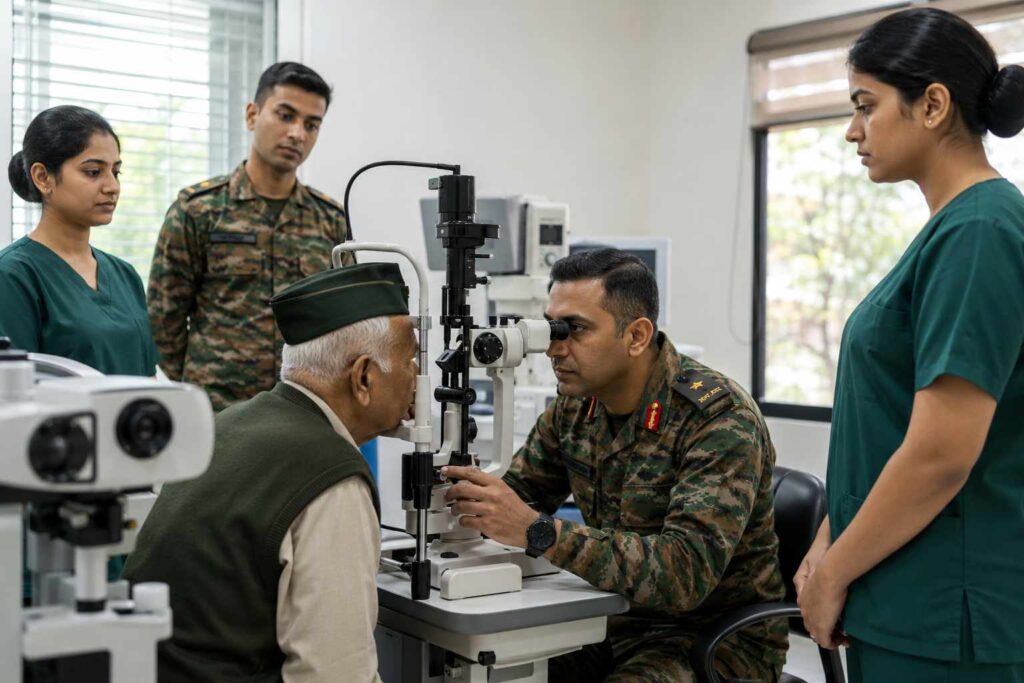
The New Delhi event also suggested something broader about the direction of military medicine. By bringing military ophthalmologists together with civilian specialists and wider expert participation, it showed that the Armed Forces medical system is not trying to work in isolation. It is opening itself to newer ideas, stronger professional exchange and updated treatment thinking. That kind of collaboration matters because better ophthalmology is no longer only about basic treatment. It is about precision diagnosis, faster intervention, better surgical outcomes and earlier detection of disease.
And that is where the welfare value becomes very real.
A person often does not think deeply about eye care until vision begins to fail. But eye problems can change daily life in quiet and serious ways. A veteran who cannot see properly may stop moving around confidently. An older dependent may begin to fear stairs, roads or night movement. A retired soldier with diabetes may not even realise that silent retinal damage is developing until vision loss becomes much harder to reverse. In each of these situations, timely eye care is not just a treatment benefit. It is a protection against loss of independence.
That is why the recent outreach work linked to military ophthalmology is so meaningful.
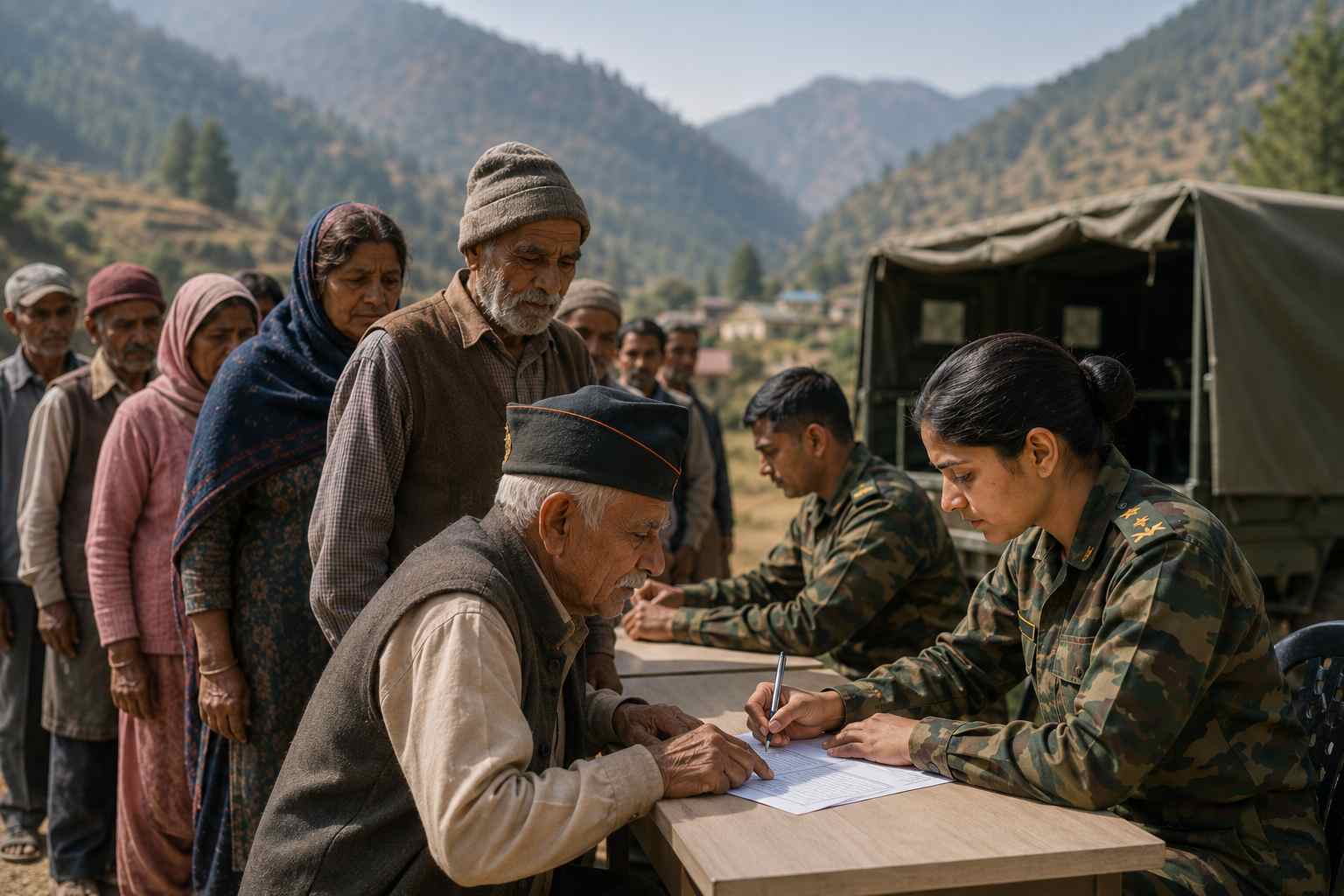
The large advanced surgical eye camps held in places like Udhampur and Gorakhpur show what military medicine can do when it moves beyond the conventional hospital wall. These efforts are important not simply because the numbers are high, but because they bring specialist care to people who may otherwise struggle to reach it in time. A veteran living in a remote district, an elderly family member dependent on local support, or a patient waiting too long for advanced care does not experience such a camp as a policy announcement. They experience it as relief.
And relief in eye care can change everything.
The restoration of sight or prevention of blindness has a different emotional power from many other forms of treatment. It directly affects how a person moves, reads, works, recognises faces and lives with confidence. That is why ophthalmology has such a strong human impact. A successful surgery may not only improve a medical condition. It may restore self-respect. It may reduce fear. It may allow a veteran to return to a more normal daily routine. It may allow a widow or dependent to live with less dependence on others.
This is where military medicine gains moral depth.
The Armed Forces have certain strengths that civilian systems often struggle to match consistently in difficult areas. They can mobilise quickly, organise teams with discipline, move equipment efficiently and create structured field support where specialist care is not always available. When those strengths are used in service of medical outreach, the result can be extremely powerful. Eye camps supported by military logistics and specialist teams become more than health events. They become examples of how national service can continue in a healing form.
Technology is making this even more important.
The use of artificial intelligence in diabetic retinopathy screening is one of the clearest signs that military eye care is entering a more preventive phase. This matters because many eye diseases do not announce themselves dramatically at the start. They advance quietly. By the time the patient notices serious symptoms, the damage may already be difficult to undo. AI-assisted screening helps change that pattern. It gives the system a chance to identify risk earlier, sort cases faster and guide patients toward treatment before vision loss becomes severe.
That is especially valuable in remote and underserved areas.
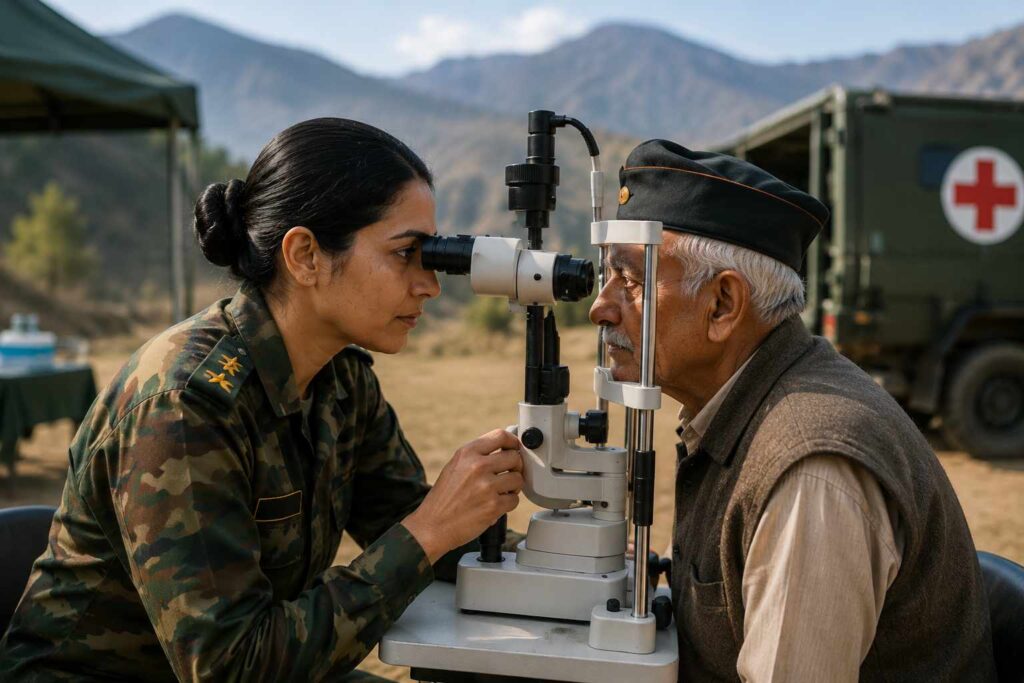
When specialist doctors are not always physically present nearby, smarter screening tools can help bridge the gap. A system that screens early and refers correctly is always stronger than one that waits for visible decline. In welfare terms, that is a major step forward. It shows that the goal is not only to perform advanced surgery once the damage is visible. The goal is also to prevent avoidable blindness before it takes hold.
This is why military eye care should not be seen as a niche medical subject.
It sits at the meeting point of service readiness, veteran welfare, dependent care and regional outreach. A soldier needs it to remain operationally effective. A veteran needs it to preserve quality of life after service. A family member needs it for basic dignity and daily functioning. A remote civilian population may benefit from it through camps and specialist access that would otherwise be difficult to reach. Very few medical stories connect so many categories of people in such a direct way.
There is also a message here for how we think about welfare more generally.
Many public discussions on defence welfare stay limited to pay, pension, canteen facilities and entitlements. Those are important, but they are not the whole picture. A strong welfare system also includes health security, medical access and specialist care that protects life after service. A retired person whose eyesight is saved at the right time has received a form of welfare that is every bit as meaningful as a financial benefit. In some cases, it may matter even more.
That is why the growing focus on military ophthalmology deserves wider attention.
It shows that the Armed Forces medical system is looking beyond emergency response and toward longer-term human well-being. It shows that expertise is being strengthened, outreach is being expanded and technology is being used to catch disease earlier. Most importantly, it shows that eye care is being understood not as a small hospital department, but as a serious part of soldier and veteran welfare.
In the end, this matters because eyesight is tied to much more than vision alone. It shapes confidence, movement, independence and dignity. When military medicine works to protect that, it is not doing a minor specialist job. It is preserving the quality of life of the people who serve, the people who have served and the families that stand behind them.
That is why military eye care is becoming one of the most human and meaningful welfare missions in the Armed Forces today.



Leave a Reply