
For lakhs of Central Government employees and pensioners, the 8th Central Pay Commission is not just a committee sitting in Delhi. It is connected with salary, pension, allowances, retirement security, service conditions and the financial future of families.
That is why even a one-page notice can become important.
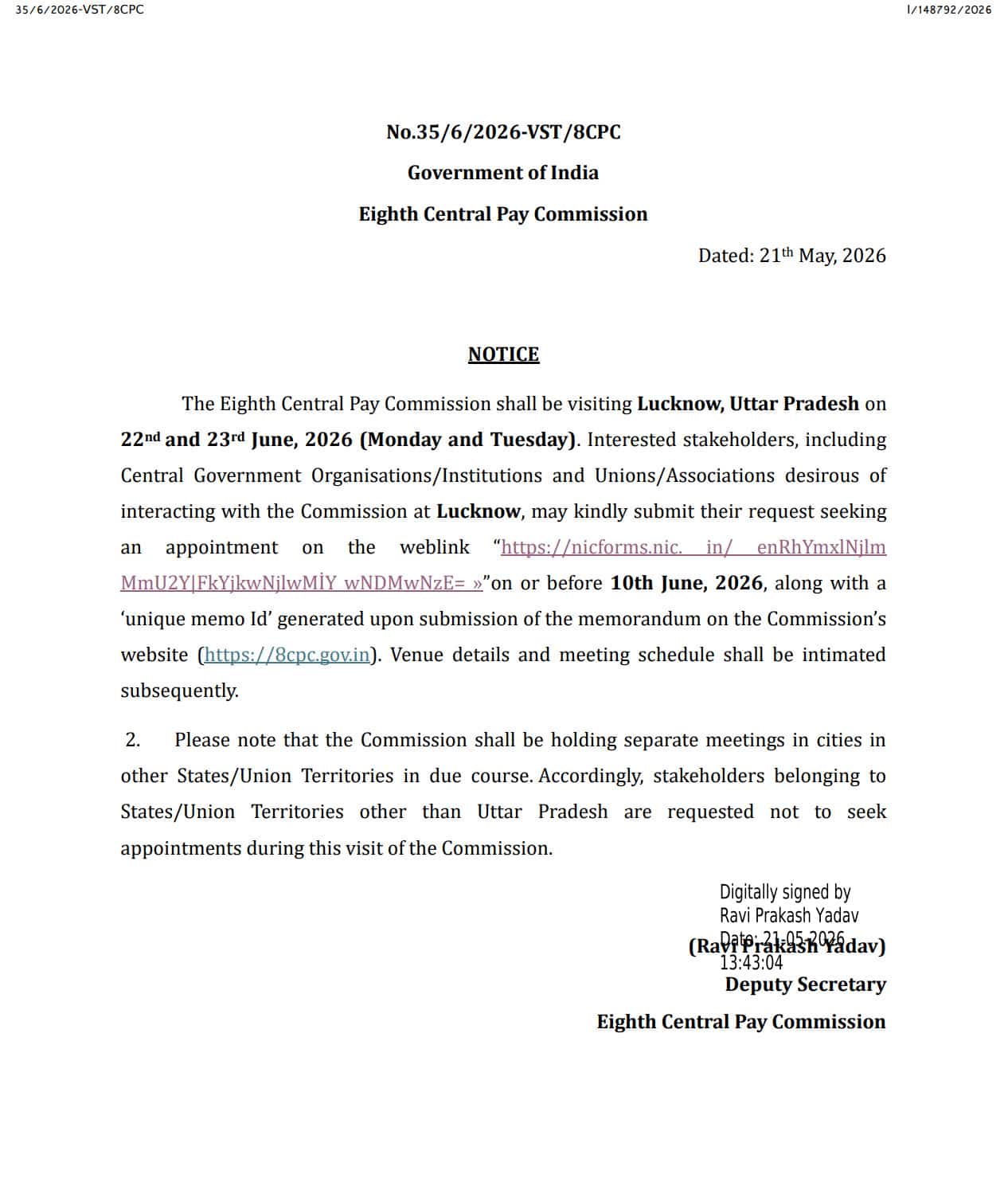
The latest notice of the Eighth Central Pay Commission says that the Commission will visit Lucknow, Uttar Pradesh on 22 and 23 June 2026. At first glance, this may look like a simple tour update. But when we read the notice carefully, the message is much bigger. This is not only about the Commission coming to Lucknow. This is about who can meet the Commission, how they can seek an appointment, what they must submit before that, and why the 10 June 2026 deadline should not be ignored.
The official 8CPC website has listed this notice under “What’s New” with the title “Notice regarding 8CPC Visit to Lucknow, Uttar Pradesh 22-23 June, 2026”, dated 21-05-2026. The official notice page also carries the downloadable document dated 21/05/2026, which confirms that this is not a social media claim or a forwarded screenshot. It is an official update from the Eighth Central Pay Commission.
The uploaded PDF also confirms the same details. It carries notice number No.35/6/2026-VST/8CPC, is issued by the Government of India, Eighth Central Pay Commission, and is signed by Ravi Prakash Yadav, Deputy Secretary, Eighth Central Pay Commission. The notice clearly mentions the Lucknow visit, the appointment request process, the unique memo ID requirement and the 10 June deadline.
This is why Uttar Pradesh-based stakeholders should treat this notice seriously.
Why this notice is more than a travel update?
A Pay Commission works through data, representations, discussions, memorandums and stakeholder inputs. Employees and pensioners often wait for the final report, but the real groundwork happens much before the final recommendations are announced.
This Lucknow visit is part of that groundwork.
The notice says that interested stakeholders, including Central Government organisations, institutions, unions and associations, who want to interact with the Commission at Lucknow, may submit their appointment request through the specified NIC form link on or before 10 June 2026. They must also provide the unique memo ID generated after submitting their memorandum on the Commission’s website.
This one condition changes the entire meaning of the notice.
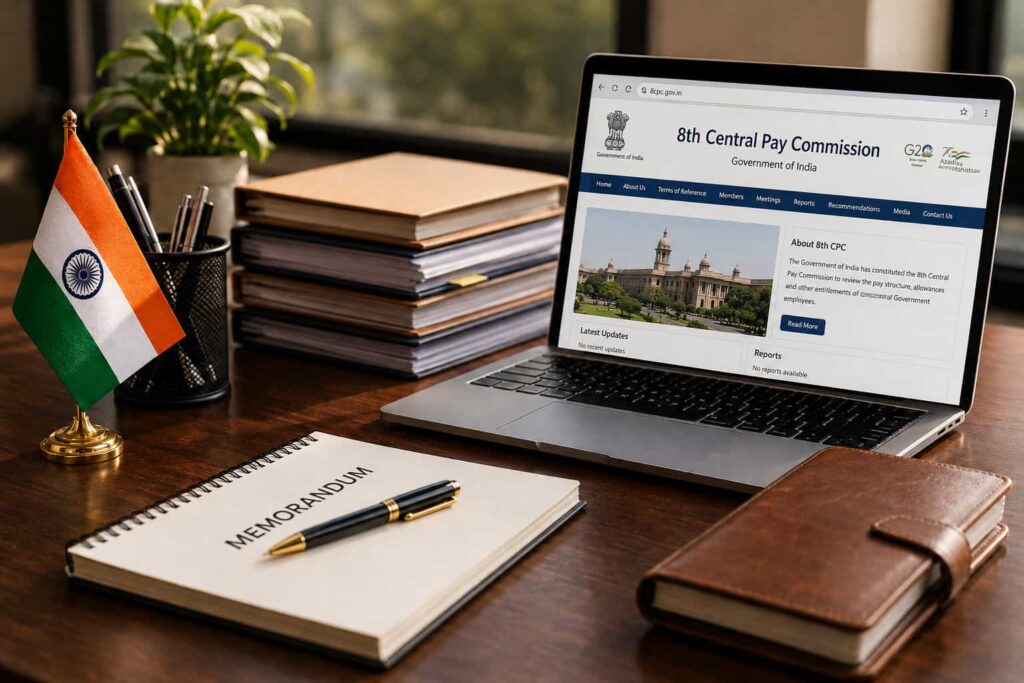
It means that simply wanting to meet the Commission may not be enough. A stakeholder must first submit the memorandum on the official 8CPC website and then use the unique memo ID while seeking an appointment for the Lucknow interaction.
For employees, pensioners, unions and associations in Uttar Pradesh, this is a clear process. First, prepare the memorandum. Second, submit it on the 8CPC website. Third, get the unique memo ID. Fourth, use that memo ID while requesting an appointment before the deadline.
The memo ID is now the key
The most important phrase in the notice is unique memo ID.
Many employees may think that a meeting request is enough. But the notice connects the appointment request with the memorandum already submitted on the Commission’s website. In simple words, the memo ID becomes proof that the stakeholder has already placed the issue before the Commission in the official format.
This is also consistent with the broader 8CPC memorandum process. The Commission’s memorandum submission page says that representations, memorandums and suggestions are invited from Central Government employees, defence personnel, pensioners, associations, unions, ministries, departments, UTs and other eligible stakeholders. It also states that submissions must be made only through the specified online link, and paper-based memoranda, hard copies, PDFs and emails are not being considered or entertained by the Commission.
That is why the Lucknow notice should not be read casually. The Commission is not asking people to come with loose papers or informal demands. It is linking interaction with the official memorandum system.
For a union or association, this means the memorandum must be clear, structured and issue-based. For pensioners’ organisations, it means the demands should be documented properly. For employee bodies, it means pay anomalies, allowance issues, cadre-specific concerns, pension-related points and service condition matters should be placed in a serious manner.
Why Uttar Pradesh stakeholders must act before 10 June?
The deadline in the notice is very specific: appointment requests must be submitted on or before 10 June 2026. The Commission will visit Lucknow on 22 and 23 June 2026, and venue details and meeting schedule will be shared later.
This gives stakeholders a small but important window.
If an association waits for the venue announcement first, it may miss the appointment request deadline. If a union prepares the memorandum late, it may not get the memo ID in time. If a pensioners’ group assumes that someone else will raise the issue, their own specific concerns may not reach the Commission in the right format.
That is the practical risk.
This is especially important in a large state like Uttar Pradesh. Central Government employees, defence pensioners, railway employees, postal employees, paramilitary personnel, civilian defence employees, audit and accounts personnel, retired employees and different service associations may have different issues. A general demand may not capture the pain of every category.
The Lucknow visit gives Uttar Pradesh stakeholders a chance to place their issues regionally and collectively, but only if they act within the process.
Why other states should not apply for this visit?
The second paragraph of the notice is also important. It says the Commission will hold separate meetings in cities in other States and Union Territories in due course. Therefore, stakeholders belonging to States and Union Territories other than Uttar Pradesh are requested not to seek appointments during this Lucknow visit.
This shows that the Commission is following a state-wise or region-wise interaction approach. Earlier notices also show similar visits and meetings for other locations, including Hyderabad, Srinagar, Ladakh, Delhi, Pune and Dehradun, which were listed on the official 8CPC “What’s New” page.
The message is clear: Lucknow is for Uttar Pradesh stakeholders. Other states should wait for their own turn rather than crowding this appointment window.
This is also a matter of fairness. If the Lucknow interaction is meant for Uttar Pradesh, then Uttar Pradesh organisations should get the opportunity to present their specific issues. At the same time, stakeholders from other states should track the official 8CPC website regularly for their own state or regional meeting notice.
What should unions and associations prepare now?
This is where the human side of the story begins.
Behind every memorandum, there is a real concern. A pensioner may be worried about medical expenses. A serving employee may be facing pay-level anomalies. A defence pensioner may be looking for fairness in pension revision. A railway or postal employee may want cadre-specific issues to be understood. A family pensioner may be worried about long-term financial security.
The Lucknow visit is not just a form. It is a chance to convert these concerns into a formal representation.
But emotional points alone may not be enough. The memorandum should be clear, factual and practical. It should explain the problem, show who is affected, give examples where possible, and suggest a reasonable solution. If a demand is connected to pay, pension, allowances, promotion, hardship, risk, service conditions or retirement benefit, it should be explained with proper logic.
A strong memorandum should not look like a slogan. It should look like a serious document.
Associations should also avoid sending scattered or duplicate demands without structure. The Commission will receive many submissions. The clearer the issue, the better the chance that it will be understood.
Why employees should not wait for “final announcement” news?
Many employees and pensioners follow only the headline part of the 8th Pay Commission. They ask: what will be the fitment factor? What will be the minimum pay? What will happen to pension? When will the report come? What will be the increase?
These questions are natural. But the important point is that the final recommendations are shaped by inputs, data and representations collected during the process.
That is why the consultation stage matters.
If an employee group waits only for the final report, it becomes too late to influence the discussion. The time to raise issues is now, when the Commission is collecting memorandums and meeting stakeholders. The Lucknow visit is part of that phase.
This is why the 10 June appointment deadline should be seen as an action deadline, not just an administrative date.
What individual employees should do?
Individual employees may not directly get a meeting unless they are part of an eligible organisation, institution, union or association. But that does not mean they have no role.
They should contact their recognised associations, employee bodies, pensioners’ groups or unions and ensure that their issue is included in the memorandum. If there is a local or department-level anomaly, they should document it properly and send it to the body representing them.
For example, if a group of employees has a pay fixation issue, they should not only say “injustice happened.” They should prepare a short note showing the old position, present position, impact and suggested correction. If pensioners have a commutation, restoration, medical or family pension issue, they should present it with clarity and supporting points.
The Commission will not understand every ground-level issue automatically. Stakeholders must explain it.
Final thought
The 8th Central Pay Commission’s Lucknow visit on 22 and 23 June 2026 may look like a simple official notice. But for Uttar Pradesh employees, pensioners, unions and associations, it is a meaningful opportunity.
The real message is not just “Commission is coming to Lucknow.” The real message is: submit your memorandum, get your unique memo ID, request an appointment before 10 June, and prepare your issues seriously.
This is the stage where silence can become costly.
For years, employees and pensioners discuss pay anomalies, pension concerns, allowances, medical benefits and retirement security among themselves. But when the formal window opens, the discussion must move from WhatsApp groups and meetings to official representation.
That is what this notice is asking for.
The 8th CPC process is moving city by city, meeting by meeting and memorandum by memorandum. Uttar Pradesh now has its window. The responsibility is on stakeholders to use it properly.
Sources:-
https://8cpc.gov.in/
https://8cpc.gov.in/document/notice-regarding-8cpc-visit-to-lucknow-uttar-pradesh-22-23-june-2026/
https://cdnbbsr.s3waas.gov.in/s354b2b21af94108d83c2a909d5b0a6a50/uploads/2026/05/20260521886747762.pdf
https://innovateindia.mygov.in/8cpc-memorandum-submission/
https://www.staffnews.in/2026/05/8th-central-pay-commission-visit-to-lucknow.html


Leave a Reply