
The 8th Pay Commission has now entered a more active stage, and that is an important update for millions of central government employees and pensioners. After the earlier Dehradun interaction plan, the Commission has now issued fresh notices for stakeholder meetings in Delhi and Pune. This shows that the process is moving beyond internal groundwork and into structured consultation.
For employees, pensioners, unions, associations, and federations that were waiting for clear signs of progress, this is a meaningful development. The latest notices indicate that the 8th Central Pay Commission has started formal interaction with recognised stakeholder bodies. These consultations could play a major role in shaping future recommendations on salary revision, fitment factor, allowances, pension structure, and career progression.
Delhi meetings fixed for 28 to 30 April 2026
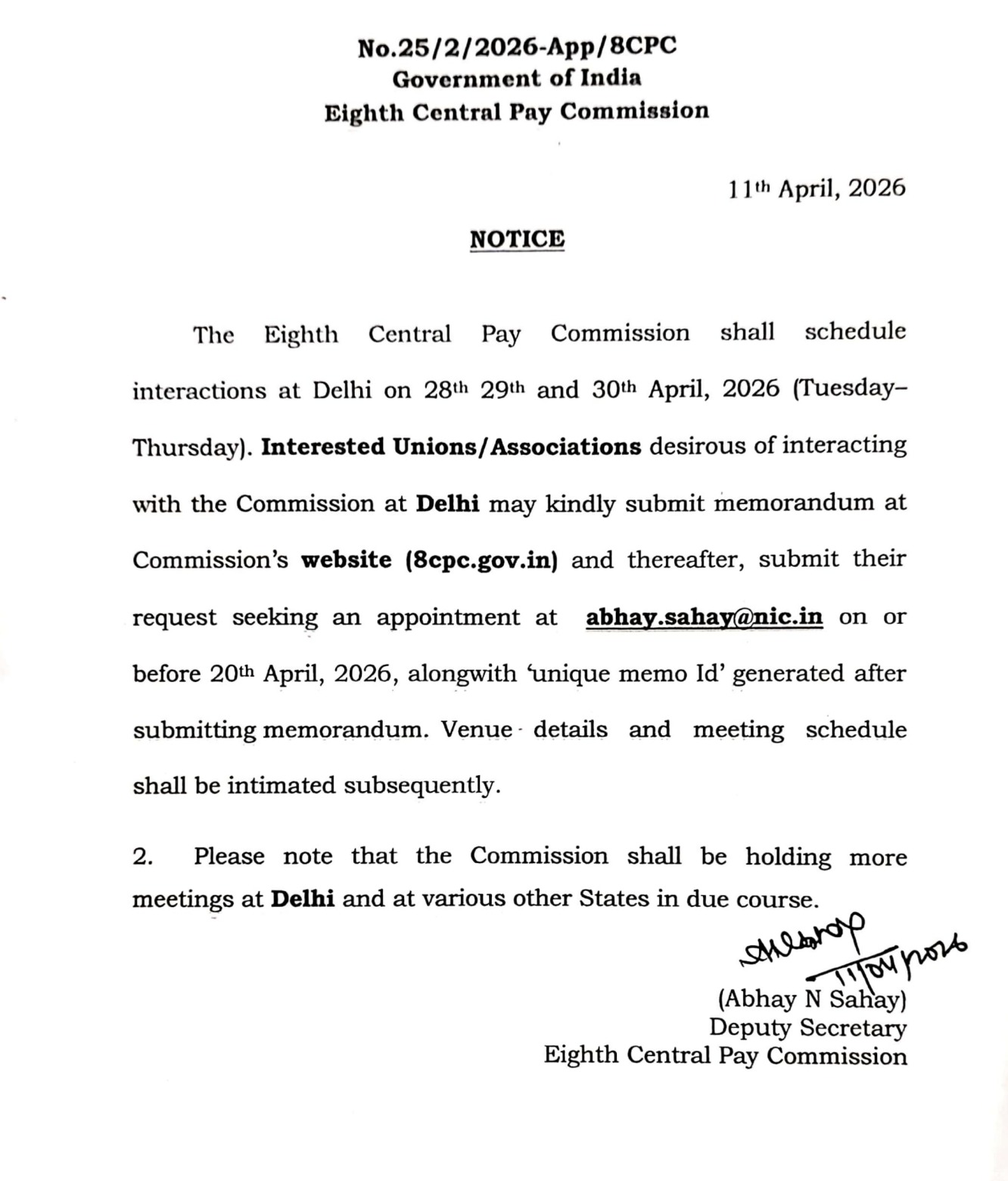
As per the latest notices dated 11 April 2026, the Commission has scheduled stakeholder interactions in Delhi on 28, 29, and 30 April 2026. Employee unions, associations, federations, and other recognised bodies that want to present their views have been asked to seek an appointment before 20 April 2026. Once approved, the exact time and venue are expected to be shared separately.
This is a major step because Delhi is one of the most important centres for such consultations. A large number of central government unions, pensioner groups, and departmental associations either operate from Delhi or maintain strong representation there. That makes these meetings especially significant. Many major service-related and pension-related concerns are likely to be formally placed before the Commission during this phase.
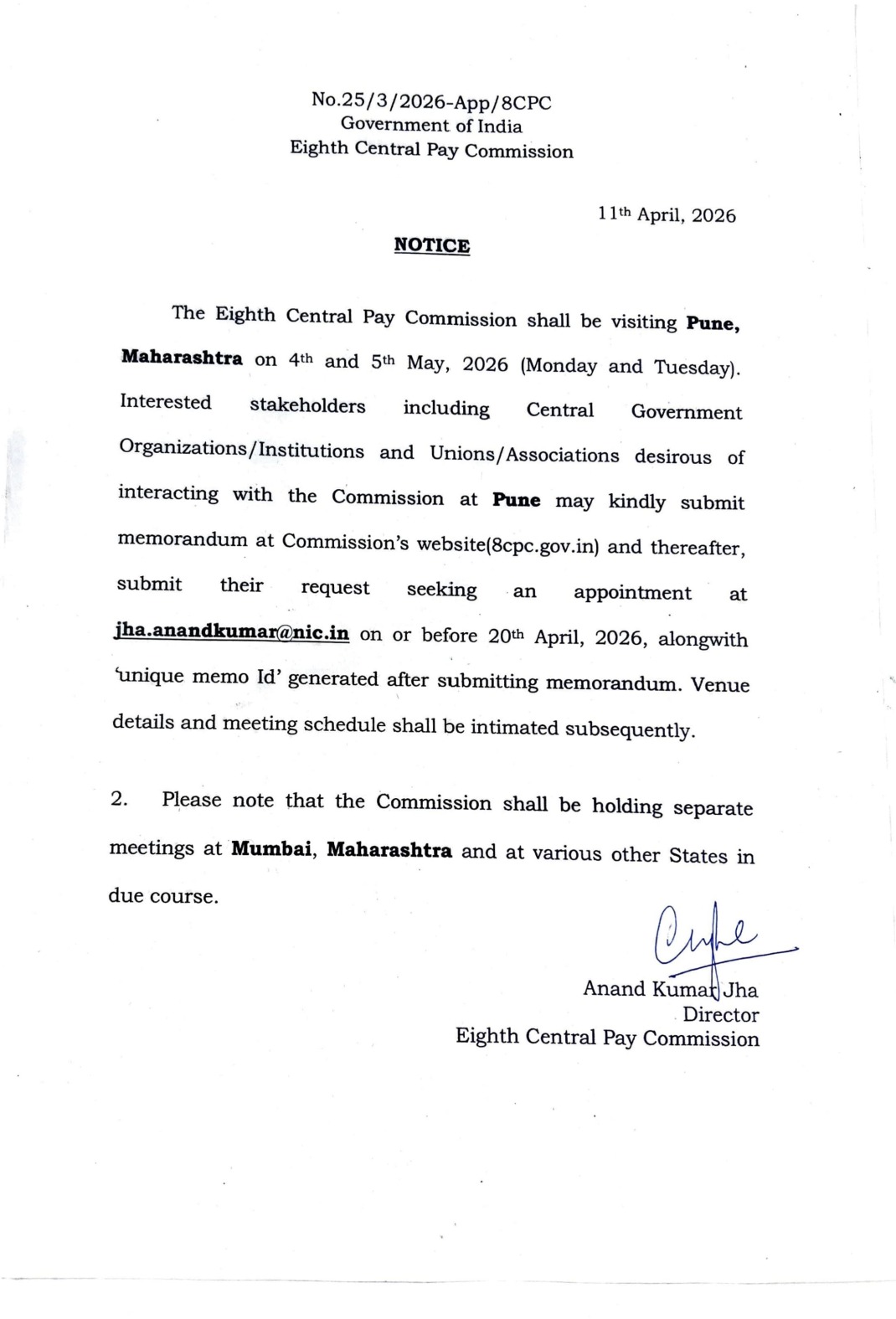
Pune meetings scheduled for 4 and 5 May 2026
The second major part of the update is the Pune schedule. The 8th CPC team is set to hold stakeholder interactions in Pune on 4 and 5 May 2026. This is important because it shows that the consultation process is not being limited to Delhi alone.
For organisations based in Maharashtra and nearby regions, this creates a valuable opportunity to directly present their issues without depending only on capital-based representation. It also suggests that the Commission may be planning a broader city-wise outreach in the coming weeks.
Why this matters beyond just meeting dates
These meetings are not just administrative formalities. In any pay commission process, stakeholder interactions often become one of the most important stages. Official files and department-level records can explain policy structures, but real issues are often better understood when unions and associations present them with practical examples.
This is where matters such as pay stagnation, cadre parity, delayed promotions, allowance distortions, pension anomalies, and MACP-related concerns can be highlighted more effectively. When such issues are presented in a clear and documented way, they are more likely to become part of the Commission’s official consideration.
More cities may be added later
Another important takeaway from this development is that the Commission appears to be building its consultation calendar in phases. First came the Dehradun plan, and now Delhi and Pune have been added. That pattern suggests more cities may be included in the next round of notices.
Even if a particular association’s city has not yet been listed, this is the right time to stay ready. The trend indicates that the consultation process could expand further, and organisations that prepare early will be in a stronger position when the next opportunity comes.
What stakeholder groups should prepare now
For recognised bodies planning to seek appointments, preparation will matter far more than reaction. A vague or overly broad representation may not have much impact. A focused memorandum with specific points and supporting examples can make a much stronger case.
Associations should ideally prepare concise submissions that clearly identify the most important issues. These could include:
- fitment factor and minimum wage logic
- restructuring of the pay matrix
- pay parity across cadres
- rationalisation of allowances
- MACP distortions
- pension revision principles
- department-specific anomalies
- NPS and OPS concerns, where relevant
Sectors such as Railways, Defence, Postal, CPSEs, and other central services may also bring their own long-pending issues into the discussion.
Real examples will matter more than general demands
The quality of representation could make a real difference. Organisations should keep service and financial data ready wherever possible. This may include pay levels, earlier grade pay history, promotion timelines, MACP progression, allowance impact, and pension implications.
General statements often carry less weight than actual case-based examples. If an association can show how a rule or structure is producing unfair outcomes on the ground, that argument becomes much stronger.
What individual employees and pensioners should do
This update is also important for individual employees and pensioners, even though these meetings are generally meant for recognised bodies and not for personal applicants.
Those who are facing genuine anomalies should not remain passive. They should send their points in writing to their unions, federations, or associations so that these issues can be included in the final memorandum. A properly documented issue raised through a recognised organisation stands a much better chance of being formally heard by the Commission.
Why pensioners should track this closely
Public discussion around pay commissions often focuses more on serving employees, but pensioners are deeply connected to the same process. Pension revision, parity concerns, and post-retirement financial fairness are all part of the broader pay commission framework.
That is why pensioner bodies should also use this phase seriously. Strong and well-prepared representations can help ensure that pension issues are not pushed to the margins. For many retired personnel, this is a crucial chance to place unresolved concerns on record before the Commission moves deeper into its internal review.
A clear sign that the 8th CPC process is moving
From the Dehradun interaction plan to fresh notices for Delhi and Pune, the overall picture is becoming clearer. The 8th Pay Commission is now moving from broad expectation to actual stakeholder engagement. This is a meaningful administrative step and not just another routine update.
For central government employees, pensioners, and representative bodies, this is the phase where serious preparation matters. It is still early enough for organised inputs to influence the direction of discussion. That is why the current appointment window is more important than it may appear at first glance.
One important caution
At a time when social media is full of unverified claims about fitment factor, salary hikes, and pension revision, stakeholders should rely only on official notices and authenticated communication. This is not the stage for rumours or premature conclusions. It is the stage for verified information, documented submissions, and structured representation.
Conclusion
The Delhi and Pune meeting schedules show that the 8th Pay Commission has begun opening its consultation process in a practical and visible way. That may sound procedural, but it is actually one of the most important phases of the entire exercise. This is where issues begin entering the official conversation, priorities start taking shape, and representative bodies get the chance to make their case.
For employees, pensioners, unions, federations, and associations, the message is simple: the window is now open. Those who want their concerns heard should use this opportunity with preparation, clarity, and facts.