
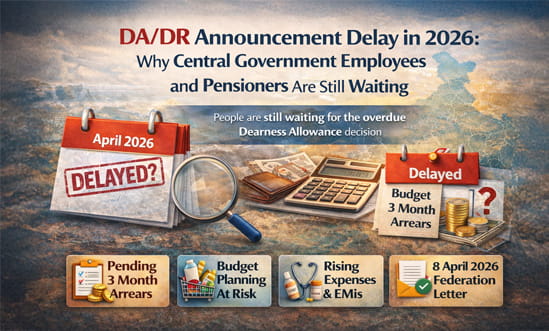
For central government employees and pensioners, Dearness Allowance and Dearness Relief are not just technical terms used in official orders. They have a direct connection with monthly life. From grocery bills and medicine costs to school fees, travel expenses, and loan payments, this revision often plays a role in household planning. That is why the continued wait for the January 2026 DA/DR announcement has become a matter of growing concern.
In a normal year, many employees and pensioners expect this revision to be announced around the end of March. Over time, that pattern has created a sense of routine. People begin to expect the revised rate, and many also look forward to the arrears that usually follow. But in 2026, that expected timeline appears to have shifted, and the absence of an announcement has led to fresh questions.
The concern is not only about the order itself. It is also about timing. For many households, the expected arrears are seen as a financial cushion. Some plan important payments around it. Others use it to manage rising household expenses or pending bills. When the usual schedule is delayed, uncertainty increases. People begin to wonder when the order will come, when the revised rate will be notified, and when the arrears will finally be credited.
This issue gained more attention after a federation letter dated 8 April 2026 reportedly raised the matter before the Finance Minister. That development gave the discussion a more formal shape. It suggested that the delay was not just being discussed informally among employees, but had also become an issue serious enough to be officially represented.
For employees and pensioners, the delay matters because the revision affects real financial decisions. At lower pay levels, even a modest arrear amount can be useful in managing the month. For pensioners and those in higher pay bands, the amount can be more substantial. In both cases, the delay creates a gap between expectation and actual payment. That gap often leads to stress, especially when essential expenses continue to rise.
It is also important to understand what this delay does not mean. A delayed announcement does not automatically mean that the benefit has been cancelled or denied. The concern at present is not about entitlement disappearing. The concern is that the formal declaration is still awaited, and without that notification, employees and pensioners continue to remain in a holding pattern.
The wait becomes even more significant because DA and DR revisions under the 7th Pay Commission are linked to CPI-IW based calculations and require official approval before they are notified. That is why every delay attracts attention. Once the expected window passes, employees, pensioners, and service associations naturally begin watching every government development more closely.
This is affecting both serving staff and retired personnel. DA applies to central government employees in service, while DR applies to pensioners. So the uncertainty is being felt on both sides. A serving employee may be thinking about monthly budgeting, while a pensioner may be more concerned about managing fixed expenses such as healthcare, utilities, or support for dependents. That is what makes this issue broader than a routine administrative update.
Another reason the topic has drawn such wide interest is that it feels personal. On paper, it may appear to be a standard revision process. But in practical terms, it affects the financial rhythm of millions of households. A delayed order can change spending decisions, delay planned purchases, and create doubt about when extra funds will actually arrive.
At times like this, misinformation also spreads quickly. Delays often lead to rumours, half-correct claims, and exaggerated interpretations online. That is why the most sensible approach is to stay focused on official developments. Once the government issues the final order, employees can verify the change in their salary slips, and pensioners can check their pension credits or pension slips. If arrears do not reflect after the processing period, the matter can then be taken up with the concerned authority.
The delay in the January 2026 DA/DR announcement has become important because it touches everyday financial life. For employees and pensioners, this is not just about a notification being late. It is about waiting for clarity in a period when household expenses are already under pressure.
Right now, the main issue is uncertainty, not loss of entitlement. People are still waiting for the formal declaration, and until that arrives, concern will naturally continue. That is why this update is being followed so closely. What looks like a routine government decision on the surface has become a significant issue for millions who depend on timely financial revisions to plan their lives better.