
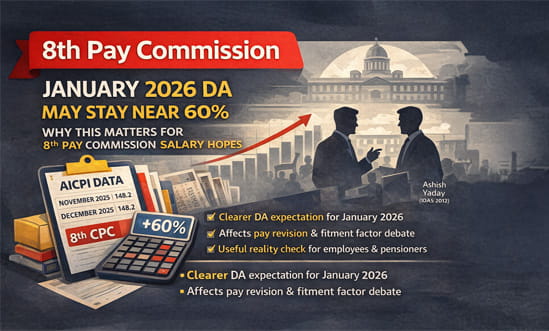
The latest inflation numbers have brought an important update for Central Government employees, pensioners, and the defence community. At a time when the 8th Pay Commission is one of the biggest topics of discussion, the newest AICPI-IW data has given a clearer idea of where Dearness Allowance and Dearness Relief may stand from January 2026.
According to the latest trend, the AICPI-IW for November 2025 moved up to 148.2, while the December 2025 figure stayed at the same level. On paper, this may look like a routine data update. But for lakhs of employees and pensioners, it is much more than that. These figures play a direct role in estimating DA and DR under the 7th Pay Commission formula, and that is why they are being watched so closely.
The current base is already known. From 1 July 2025, the government had increased DA and DR from 55 percent to 58 percent. After that, all eyes shifted to the next revision due from 1 January 2026. With November rising and December holding steady, the picture now looks much more stable. The strongest expectation is that DA/DR will move close to 60 percent, rather than jump to a much higher number.
This is where the update becomes even more important. For many viewers and readers, DA is not just a monthly relief component. It is also being seen as an indicator for what may happen later under the 8th Pay Commission. A lot of social media posts and public discussions link DA levels with future fitment factor expectations, possible salary correction, and pension revision. That is why this 60 percent zone is being discussed so widely.
But there is one thing readers should keep in mind. A likely 60 percent DA does not mean the 8th Pay Commission has finalized any fitment factor. That has not happened yet. The Commission has not officially declared any multiplication factor for salary or pension revision. So while the DA trend helps people estimate future possibilities, it should not be mistaken for a final 8th CPC decision.
This difference matters because many misleading claims online try to turn partial data into confirmed news. Inflation data can help us understand direction. It can tell us whether DA is likely to rise modestly or sharply. But it cannot, by itself, confirm the final structure of the next pay commission. That decision will depend on the Commission’s recommendations and the government’s final approval.
Even so, the latest AICPI pattern does give one useful message. It suggests that January 2026 DA/DR is moving toward a realistic and stable level, and that makes financial planning easier for employees and pensioners. It also helps cut through exaggerated claims that often create false expectations around massive pay revision or unusually high fitment factors.
The larger 8th Pay Commission story is still developing. Salary revision, pension changes, fitment factor, allowances, and parity issues will all be decided through a much bigger process. The Commission is currently in a consultation and representation stage, where employees, pensioners, associations, ministries, and other stakeholders are expected to submit their views. That means the current phase is not about final numbers. It is about shaping the debate before final recommendations are prepared.
For readers, the biggest takeaway is simple. The latest AICPI figures may not have decided the 8th CPC outcome, but they have made the January 2026 DA picture much clearer. Right now, the most realistic view is that DA/DR will stay around 60 percent. That may sound like a small technical update, but in the larger 8th Pay Commission discussion, even one such number can influence expectations around salary, pension, and future revisions.
In other words, this is not just another inflation data story. It is a reality check for everyone following the 8th Pay Commission. It tells employees and pensioners to stay informed, stay realistic, and look at official trends rather than viral claims. And in today’s environment, that kind of clarity matters more than ever.