
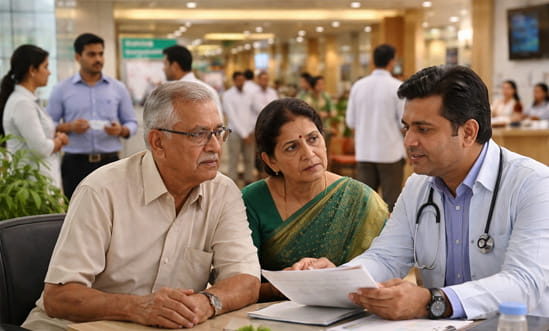
For millions of central government employees and pensioners, healthcare is not just another service linked to employment. It is one of the most important pillars of security. A dependable medical support system can reduce financial pressure, support families in times of crisis, and offer peace of mind during retirement. That is why the renewed discussion around the future of CGHS has started attracting serious attention after the announcement of the 8th Pay Commission.
Whenever a new Pay Commission is announced, public attention usually turns first to salary hikes, pension revision, allowances, and fitment factor. But the role of a Pay Commission is much wider than that. It also reviews welfare-related systems that shape the everyday lives of employees and pensioners. Healthcare is one of the most important among these. In the present context, that makes the future of the Central Government Health Scheme a major issue to watch.
CGHS has been the primary healthcare support framework for central government employees, pensioners, and their dependents for many years. It is meant to provide consultations, medicines, diagnostic services, and hospital treatment through a structured network of empanelled facilities and wellness centres. For many beneficiaries, especially those living in well-covered cities, the system has served as an important support mechanism. Yet over time, one issue has continued to stand out above all others: access.
The problem with CGHS has never been only about intent. The larger concern has always been about practical reach. Healthcare support works best when it is available quickly, easily, and close to where people actually live. This is where many beneficiaries feel the present system falls short. In places where CGHS infrastructure is limited or missing, employees and pensioners often face inconvenience, delay, and uncertainty. For retired personnel, that challenge can become even more serious, because medical support in later years is not optional. It is essential.
This is exactly why the idea of changing or upgrading the current system has surfaced repeatedly over the years. The discussion did not begin with the 8th Pay Commission. In fact, earlier Pay Commissions had already acknowledged that the existing healthcare model needed fresh thinking. The 6th Pay Commission had proposed an optional health scheme for employees and pensioners, one in which members could join by contributing a fixed amount. It also suggested that future recruits could eventually be brought into such a framework in a more structured way. The broader message was clear: the existing arrangement needed a more practical alternative.
The 7th Pay Commission went even further and gave stronger weight to the idea of an insurance-led healthcare system. Its approach reflected a more modern understanding of employee welfare. Rather than relying only on a geographically limited government-run arrangement, the commission viewed health insurance as a potentially better way to provide long-term medical protection to employees, pensioners, and their families. It was not just speaking about treatment. It was speaking about reach, continuity, and reliability.
An especially important point raised by the 7th Pay Commission was the situation of pensioners living outside the regular reach of CGHS facilities. For them, even a scheme that exists on paper can feel distant in practice. To ease that difficulty, the commission recommended improving access through hospitals already linked to CS(MA) or ECHS, so that more pensioners could get cashless care without being restricted by geography. That suggestion reflected an important truth: a healthcare benefit has value only when it can be used without struggle.
That is why the recent buzz around a possible insurance-based replacement for CGHS has caught so much attention. Reports that surfaced in early 2025 suggested that the Health Ministry was examining the idea of a fresh model, possibly under the name Central Government Employees and Pensioners Health Insurance Scheme, or CGEPHIS. While there is no final official rollout yet, even the possibility of such a move has reopened the conversation in a much bigger way.
The interest around a new scheme is understandable. An effective insurance-based system could potentially solve several long-standing concerns at once. It could widen hospital access, improve portability across cities, reduce dependency on a limited number of centres, and make treatment more practical for pensioners living away from large urban zones. For serving employees too, such a model could be seen as a more adaptable answer to present-day healthcare realities.
The timing of this debate also matters. Medical expenses continue to rise. Families are increasingly spread out across states and cities. Many retired employees now live in places different from their last posting or service location. In such a situation, the limitations of a fixed-location healthcare network become more visible. People do not only want medical entitlement. They want a system that works when an emergency happens, when regular treatment is needed, and when family members are trying to arrange care without delay.
This is where the 8th Pay Commission may become significant beyond the question of pay revision. If it takes a serious view of healthcare reform, it could influence one of the most meaningful changes in employee welfare policy in recent years. This would not be a technical change alone. It would directly affect the daily lives of employees, retired personnel, and their families.
At the same time, any future model will need to answer important practical questions. A new scheme cannot succeed only because it sounds modern. People will want to know whether it will remain cashless, how much contribution may be required, whether pensioners will receive full and fair protection, how broad the hospital network will be, and whether the benefits will truly improve compared to CGHS. Without clear answers, even a promising reform can create uncertainty.
There is also another possibility that cannot be ignored. The government may decide not to replace CGHS completely, but to improve it from within. That too could be a major reform. A more digitally efficient CGHS, backed by wider empanelment and better regional reach, could address many of the same complaints without a full structural shift. In that case, the focus would move from replacement to modernization.
So the real question may not simply be whether CGHS stays or goes. The deeper question is whether the government is now prepared to build a healthcare support system that matches the realities of today’s employees and pensioners. That is what makes this issue so important.
For now, there is no final verdict. But one thing is certain: healthcare reform has emerged as one of the most closely watched subjects linked to the 8th Pay Commission. Employees and pensioners are not just waiting for a better pay package. They are also hoping for a healthcare framework that is wider, easier to use, and more dependable in real life.
If the coming months bring clarity, this could become one of the most important welfare discussions for central government families in recent times. Whether the future lies in a redesigned CGHS or a new insurance-based model, the expectation remains the same: a system that offers real support when it matters most.