

When people talk about a Pay Commission, the first thing that usually comes to mind is salary revision. For lakhs of central government employees and pensioners, the biggest expectation is often linked to basic pay, fitment factor, allowances, and pension changes. But that is only one part of the bigger picture.
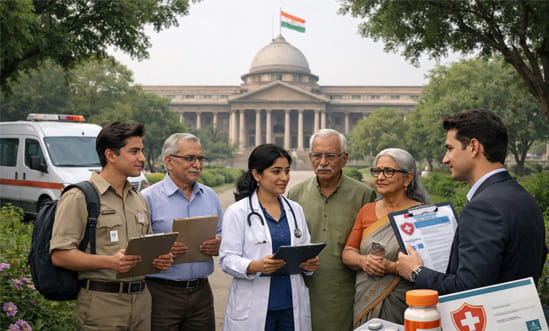
Every Pay Commission also becomes an opportunity to revisit long-pending issues that directly affect daily life. One of the most important among them is healthcare. And this is exactly why the future of the Central Government Health Scheme, or CGHS, has once again come into focus after the announcement of the 8th Pay Commission.
For years, employees and pensioners have raised concerns about the limitations of CGHS. While the scheme has served a large number of beneficiaries, its uneven reach and practical difficulties have kept the debate alive. Now, with discussions around a possible insurance-based alternative gaining fresh attention, many people are asking the same question: will the 8th Pay Commission finally push for a new healthcare model for central government staff and pensioners?
The answer is not official yet, but the issue is serious enough to deserve close attention.
CGHS has long been the backbone of government-backed healthcare support for central government employees, pensioners, and their dependents. It offers access to consultations, diagnostic services, medicines, treatments, and hospital care at approved facilities. In principle, it is meant to provide comprehensive medical support at affordable rates. For many beneficiaries living in areas where the system works efficiently, CGHS continues to be an important support structure.
However, the real challenge begins when accessibility and convenience are taken into account. The biggest criticism of CGHS over the years has not been its intent, but its limited reach and inconsistent ease of use. The scheme is not equally available across the country. In several places, especially where CGHS infrastructure is weak or absent, beneficiaries face difficulty in availing timely and seamless medical treatment. For pensioners living away from major cities, this becomes an even bigger concern.
That is one of the main reasons why the discussion around a more practical and wider healthcare model has continued across multiple Pay Commissions.
The idea of moving beyond CGHS is not new. In fact, earlier Pay Commissions had already highlighted the need for reform. The 6th Pay Commission had suggested that the government introduce an optional healthcare scheme for employees and pensioners. Under that proposal, existing employees could choose to join by paying a fixed contribution, while new employees entering service in the future could be brought under it compulsorily. The commission also recommended that the benefit should cover those retiring after the rollout of the scheme.
The 7th Pay Commission went a step further. It gave stronger backing to the concept of health insurance as a more suitable long-term solution. Its view was that a proper insurance-based system could offer broader and better protection to employees, pensioners, and their families. In simple terms, the commission felt that the future of government healthcare support should move toward a model that is more portable, more accessible, and more practical than the current arrangement in many cases.
The 7th Pay Commission also recognised a major ground-level issue faced by pensioners who lived outside the effective coverage of CGHS. It suggested that hospitals already empanelled under CS(MA) or ECHS should also be brought into the CGHS-linked treatment network so that pensioners in such regions could access cashless care. This was seen as an important interim solution that could reduce long-standing grievances, especially among retirees who struggled with limited access to CGHS services.
This recommendation was important because it acknowledged a simple reality: a healthcare scheme is only as good as its accessibility. A benefit that exists on paper but cannot be used conveniently during a medical emergency loses much of its value.
That is why the latest discussions around a possible insurance-based replacement have attracted so much attention. In January 2025, reports indicated that the Health Ministry was considering replacing CGHS with a new insurance-oriented framework, reportedly called the Central Government Employees and Pensioners Health Insurance Scheme, or CGEPHIS. While no final implementation has been announced, the very fact that such a proposal is being discussed has revived old expectations.
For central employees and pensioners, this is not just an administrative change. It could shape the future of how medical support is delivered to lakhs of families. A well-designed insurance-based scheme could potentially reduce regional limitations, widen hospital access, improve portability, and offer a more uniform healthcare experience across India. That is the hope many people are attaching to this conversation.
At the same time, there is also a note of caution. Replacing a long-standing system like CGHS is not a simple matter. Any transition would need to be carefully structured. Employees and pensioners would want clarity on coverage, premium contribution, treatment limits, hospital networks, claim settlement processes, and continuity of benefits. Pensioners, in particular, would be closely watching whether a new system genuinely improves access or simply changes the name of the framework without solving old practical problems.
This is where the 8th Pay Commission becomes important.
The newly announced commission is expected to review salary and pension structures in light of present economic conditions, but its role can go far beyond pay revision. Like earlier commissions, it can also examine the wider support ecosystem available to central government employees and retirees. Healthcare is one of the most critical parts of that ecosystem. If the commission chooses to seriously examine the future of CGHS and the possibility of an alternate model, it could end up influencing one of the most meaningful reforms for government staff in recent years.
The larger significance of this debate lies in the changing needs of beneficiaries. Medical costs are rising. Families are increasingly spread across different cities. Retirees are living longer and often need more regular care. In such a situation, a scheme designed decades ago may naturally need structural updates. The demand is no longer only for subsidised treatment. The demand is for dependable, accessible, cashless, and geographically practical care.
That is why this issue matters deeply to both serving employees and pensioners. Salaries matter, pensions matter, and allowances matter, but healthcare affects security at a much more personal level. A strong medical support system can reduce financial anxiety, ease family burden, and improve quality of life, especially during old age.
For now, there is no confirmed announcement that CGHS will definitely be replaced. But the signals are strong enough to keep the issue in focus. Previous Pay Commissions have already laid the groundwork by recommending change. Policy discussions have hinted at a new insurance-based direction. And now, with the 8th Pay Commission set to begin its work, expectations are naturally rising.
What happens next will depend on how seriously the new commission addresses this unresolved question. Will it simply note the issue once again, or will it push the government toward a concrete and implementable solution? That is the key point employees and pensioners will be watching in the months ahead.
One thing is clear. The conversation has moved beyond whether reform is needed. The real question now is whether the 8th Pay Commission will finally turn years of discussion into a practical healthcare solution that works for everyone, not just for those living within the comfortable reach of the current system.
For lakhs of central government employees and pensioners, that answer may matter just as much as the pay revision itself.